


Climbing the Marble Mountains: Huyen Khong Cave and the Temples Between the Peaks
📋 Table of Contents
First Time Setting Foot on Marble Mountains – I Understood Why Da Nang Locals Call It “The Soul of the City”
One morning, I woke up at 5:30 AM and rode my motorbike from the center of Da Nang to the south along Truong Sa street, just as the sun was peeking over the distant hazy green limestone mountains. In the strange silence of a city not yet awake, I truly felt that Marble Mountains were not just a tourist spot – it was a living entity, breathing, and telling stories in its own way.
The experience of climbing Marble Mountains, exploring Huyen Khong Cave and Tam Thai Pagoda is one that I recommend to anyone visiting Da Nang – not because it’s famous, but because it will change the way you see this land. The following article is everything I’ve gathered after many years living in Da Nang, having climbed Marble Mountains no less than twenty times, brought friends and family from all over to explore, and observed all kinds of tourists – from those who were wildly successful to those who returned empty-handed due to lack of preparation.
What Are Marble Mountains? History, Legends, and Unparalleled Beauty
Five Mountains, Five Elements, One Soul
Marble Mountains – also known as Non Nuoc – is a cluster of five marble mountains located about 9km south of Da Nang city center, in Hoa Hai ward, Ngu Hanh Son district. The five mountains are named Kim Son, Moc Son, Thuy Son, Hoa Son, and Tho Son – corresponding to the five elements in Eastern philosophy. Among them, Thuy Son is the largest and the center of all sightseeing activities, home to the legendary Huyen Khong Cave and Tam Thai Pagoda.
What few people know is that Marble Mountains are not actually “five separate mountains” in the literal sense. Seen from above, they resemble jade gems scattered on a carpet of fine white sand, nestled between the East Sea and the poetic Co Co River. This terrain creates a special microclimate: mornings are usually a few degrees cooler than the city center, while midday can be hotter as the rocks absorb heat.
Historical Imprints Through Centuries
Marble Mountains are recorded in historical texts from the 17th century, but they were actually a sacred place for the Cham people centuries before that. The Cham called this place the “Cham Islands on land” and considered it a place of worship for deities. When the Nguyen dynasty took over this region, the kings – especially King Minh Mang – ordered the construction and renovation of many pagodas and officially named each mountain according to the five elements.
In 1825, King Minh Mang personally visited Marble Mountains, bestowed many royal decrees, and had stone steles engraved to record this event. These steles remain intact to this day, humbly located in hidden corners of the pagodas – something most tourists on crowded tours overlook.
During the resistance war against America, Marble Mountains became an important revolutionary base. The natural cave system within the mountains sheltered hundreds of soldiers, wounded personnel, and civilians. To this day, many caves still bear traces of those historical times.
Beauty Beyond Words
I have visited many mountains in Vietnam – Fansipan, Ba Na, Langbiang – but Marble Mountains possess a completely different kind of beauty. It’s not the overwhelming grandeur of high mountains, but the subtlety and depth of a multi-layered space: light filtering through limestone arches, the sound of temple bells echoing from within the caves, the scent of incense mingling with the moisture from natural springs inside the caverns…
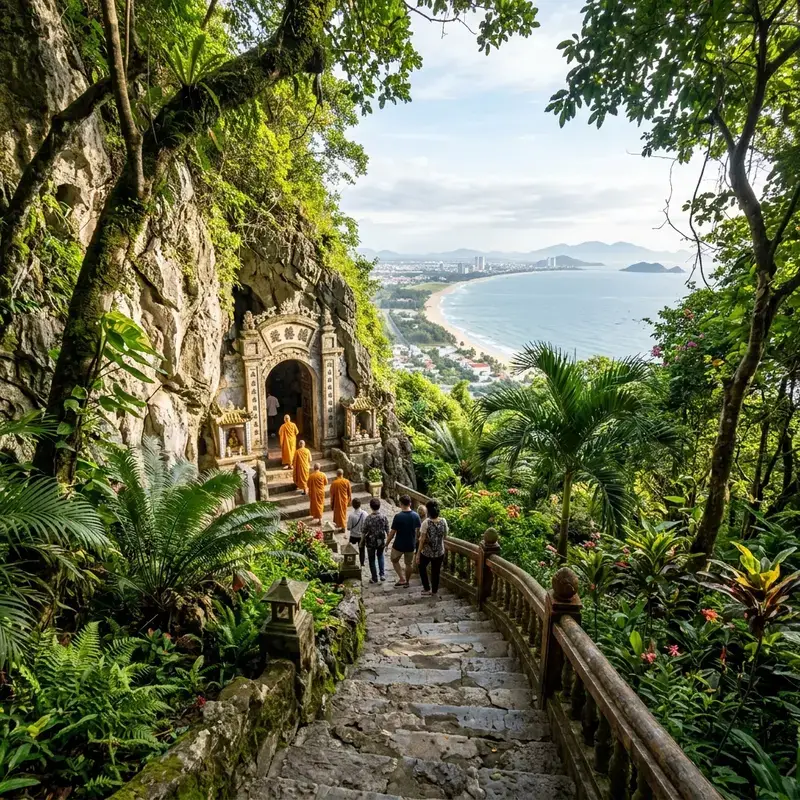
Huyen Khong Cave – The Heart of the Marble Mountains
Stepping Into Another World
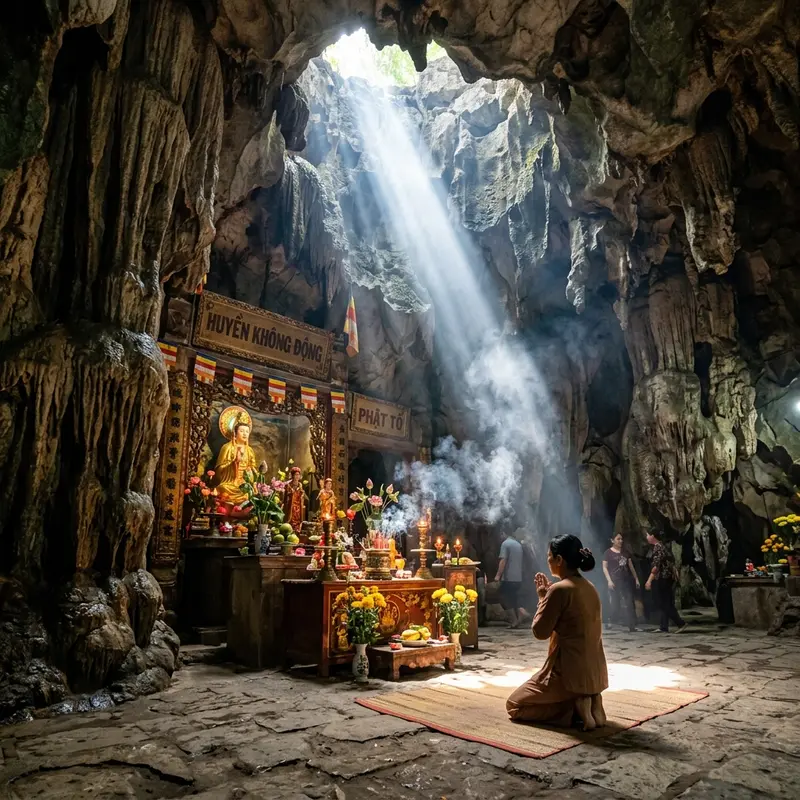
If the Marble Mountains are the soul of Da Nang, then Huyen Khong Cave is the heart of that soul. This is the most beautiful, sacred, and impressive cave in the entire cave system of Thuy Son Mountain – and in my opinion, one of the most beautiful caves in Southeast Asia that not everyone knows about.
To enter Huyen Khong Cave, you must climb a rather steep and narrow set of stairs, winding through giant rocks. The moment you pass through the narrow cave entrance and suddenly stand before a vast, soaring space like a natural cathedral – that’s a feeling words cannot adequately describe.
Magnificent Natural Architecture
Huyen Khong Cave is about 1,000m² with a ceiling height of up to 30m. The most distinctive feature is five natural openings in the rock ceiling – locals call them “heavenly eyes” or “sun eyes.” In the mornings, from about 8 AM to 10 AM, sunlight streams through these openings, creating brilliant golden rays that shine directly into the cave, illuminating the Buddhist altar and the stone statues within. This is the most divine moment in Huyen Khong Cave, and if you miss it, you’ve missed 70% of its beauty.
[!TIP] To witness the “heavenly eyes” light at its best in Huyen Khong Cave, be at the cave entrance before 8 AM. From March to August is the period when the sunlight is most beautiful due to the sun’s angle. Avoid visiting on cloudy days, as the light effect will be absent.
Inside the cave, there are many statues of Buddhas, Bodhisattvas, and deities carved from marble and placed in natural rock niches. Notably, there is a natural well deep within the cave – locals believe its water possesses sacred properties, and generations have come here to collect water for worship. The well never runs dry, even during severe droughts.
On the cave walls, there are also many poems and couplets carved into the stone from the time of the Nguyen lords and kings. These are invaluable historical records, but unfortunately, most mass-market tour guides overlook them due to time constraints.
Other Caves on Thuy Son Mountain
Besides Huyen Khong Cave, Thuy Son Mountain has many other caves worth exploring:
- Tang Chan Cave: A place of worship for deities, with many ancient stone statues and a very tranquil atmosphere. Few tourists know about it, so it’s usually less crowded.
- Van Thong Cave: A smaller cave but with peculiar rock formations, requiring you to stoop to enter – not suitable for those afraid of confined spaces.
- Linh Nham Cave: Located on the western slope, it’s less visited, but offers a beautiful panoramic view of Non Nuoc fishing village.
Tam Thai Pagoda – Where Buddhism Meets Heaven and Earth
The History of the Mountain-Top Pagoda
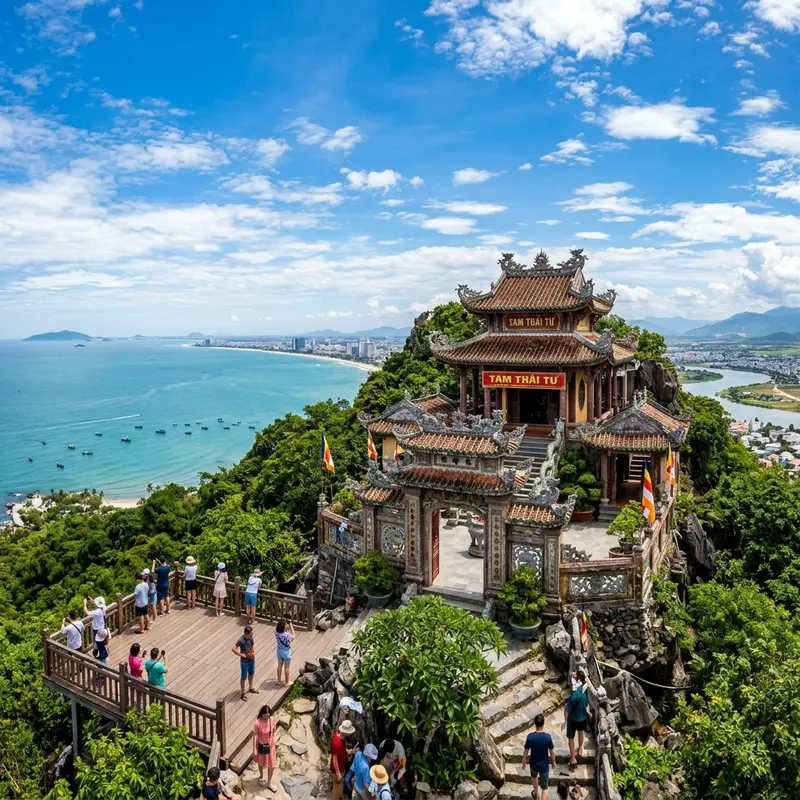
Tam Thai Pagoda is the oldest and most important pagoda in the Marble Mountains, built in the 17th century during the reign of Lord Nguyen Phuc Chu. The name “Tam Thai” originates from the Buddhist concept of three realms of existence: the realm of desire, the realm of form, and the formless realm. The pagoda is situated at the highest point on Thuy Son Mountain, overlooking the vast East Sea and the majestic Truong Son mountain range.
What few people know: Tam Thai Pagoda has undergone many renovations but still retains its original Nguyen-era architecture in many sections.important. In particular, the stone stele gifted by King Minh Mang in 1825 remains intact, standing majestically in the pagoda courtyard – a priceless historical artifact you can touch and feel.
Architecture and Spiritual Space
Tam Thai Pagoda features architecture in the Hue imperial style with yin-yang tiled roofs, gilded red lacquered wooden pillars, and a rich collection of statues. A special characteristic is that the pagoda is built in complete harmony with the natural terrain of the mountain – not a single rock was broken or moved, all integrated into the architecture with great finesse.
The spacious courtyard is paved with green stone, dotted with hundreds-year-old ancient trees providing shade. In the early morning, when mist still lingers around the mountain, standing in the pagoda courtyard and looking out at the sea is a natural meditative experience – whether you are Buddhist or not.
[!NOTE] Tam Thai Pagoda is a sacred place of worship, where monks still reside and practice their daily routines. When visiting the pagoda, please dress modestly (shoulders and knees must be covered), speak softly, and absolutely do not take selfies at the main altar. This is not only a rule of politeness but also a sign of respect for a sacred place.
From the Top of the Pagoda Overlooking the East Sea
One of the most enjoyable experiences I had at Marble Mountains was climbing to the highest level of the Xa Loi Tower next to Tam Thai Pagoda. From here, you can see:
- Non Nuoc Beach stretching out like a white silk ribbon
- Son Tra Peninsula with Linh Ung Pagoda on its summit
- Thuan Phuoc Bridge and Dragon Bridge winding across the Han River
- To the far south, Hoi An with its characteristic ancient rooftops
- On clear days, you can even see Cham Island
This is a rare 360-degree view that no man-made building or observation point in Da Nang can compete with.
Detailed Guide to Traveling to Marble Mountains
From Da Nang City Center
Marble Mountains is about 9-10km from Da Nang city center, heading south along Truong Sa Street or Le Van Hien Street. There are many ways to get there, but not all are suitable for every traveler.
Self-drive scooter: Suitable for young people who are familiar with the roads, know how to ride, and want the freedom to explore. However, Da Nang’s roads have many complex intersections, and drivers here are quite fast. If you are not used to driving in Vietnam, I do not recommend this.
Taxi/Grab: Convenient but with some practical issues: (1) After finishing your visit, calling a Grab in the Marble Mountains area can sometimes take 15-20 minutes of waiting, especially during midday when the sun is intense; (2) Many taxi drivers refuse to use the meter or overcharge tourists; (3) If you want to combine multiple destinations in a day (Marble Mountains + Hoi An, for example), calling individual trips is very expensive and time-consuming.
All-inclusive shuttle service: This is the option I always recommend to tourists, especially families with young children, the elderly, or groups of friends who want to optimize their time.
Why Choose Faifo Express?
After many years of taking friends and family on tours around Da Nang, I have tried almost every mode of transportation. And the answer I always give now is: Faifo Express – a professional shuttle service by Da Nang locals.
Specific reasons:
Drivers are locals who understand the terrain: Faifo Express drivers not only know the roads but also know how to drive – what time to depart to avoid traffic jams, where to park closest to the entrance,even knowing little tips like which shortcuts help avoid crowds in the mountain area.
All-inclusive service, no extra charges: You book in advance, know the price clearly, and don’t have to worry about being overpriced or facing additional fees. This is especially useful if you want to combine Marble Mountains with other destinations like transport to Hoi An, Ba Na Hills, or need airport transfer in Da Nang at the end of the day.
Safe and punctual: Vehicles are regularly maintained, and drivers are professionally licensed and experienced. This is particularly important when traveling with children or the elderly.
Flexible itinerary: Unlike fixed tours, Faifo Express allows you to adjust your sightseeing time according to your actual needs. Want to spend an extra 30 minutes in Huyen Khong Cave waiting for the perfect light? Absolutely possible.
[!TIP] If you’re flying into Da Nang and want to go directly to Marble Mountains on your first day, book the airport transfer service combined with sightseeing. The driver will pick you up at the airport, take you to Marble Mountains, and then to your hotel – saving significant time and effort compared to arranging each leg yourself.
Suggested Itinerary from Hoi An
If you’re in Hoi An and want to visit Marble Mountains, the distance is only about 20km – it can be combined into a full day of exploration. Transport from Hoi An to Marble Mountains, then continuing to explore central Da Nang or vice versa is a very popular and efficient itinerary.
Real Experience: Marble Mountains Climbing Itinerary from A to Z
Ideal Itinerary for One Day
6:30 AM – 7:00 AM: Depart from Da Nang city center. Purchase tickets at the main entrance.
7:00 AM – 7:30 AM: Take the elevator or hike up Thuy Son Mountain. Visit Tam Thai Pagoda and enjoy the sunrise from the pagoda grounds.
7:30 AM – 9:30 AM: Explore Huyen Khong Cave (this is the golden hour for the best light). Then visit Tang Chon Cave and Van Thong Cave.
9:30 AM – 10:30 AM: Climb to Vong Giang Dai and Vong Hai Dai peaks for panoramic views.
10:30 AM – 11:30 AM: Explore the Non Nuoc stone carving village at the foot of the mountain.
11:30 AM – 1:00 PM: Have lunch at seafood restaurants near Non Nuoc Beach.
1:00 PM onwards: Rest or combine with visiting other attractions.
Beautiful Check-in Spots That Few People Know About
After visiting many times, I’ve discovered some beautiful photo spots that tour guides never show:
-
The entrance to Huyen Khong Cave viewed from the inside: Standing inside the cave and looking out, you’ll see a landscape painting – the natural rock arch as a frame, with green trees and morning light outside. This is the best angle but requires a camera with good backlight processing capabilities.
-
The stone steps leading to Tam Thai Pagoda at sunrise: Moss-covered stone steps, lush trees on both sides, light filtering through the canopy – this is a favorite angle for professional photographers.
-
Tam Thai Pagoda courtyard overlooking the sea: Standing on the eastern balcony of the pagoda courtyard, with the vast blue sea in front and ancient tiled roofs behind – a perfect photo frame.
-
The small cave entrance leading to Van Thong Cave: The narrow and low cave entrance creates a very interesting “frame within a frame” effect in photos.
Non Nuoc Stone Carving Village
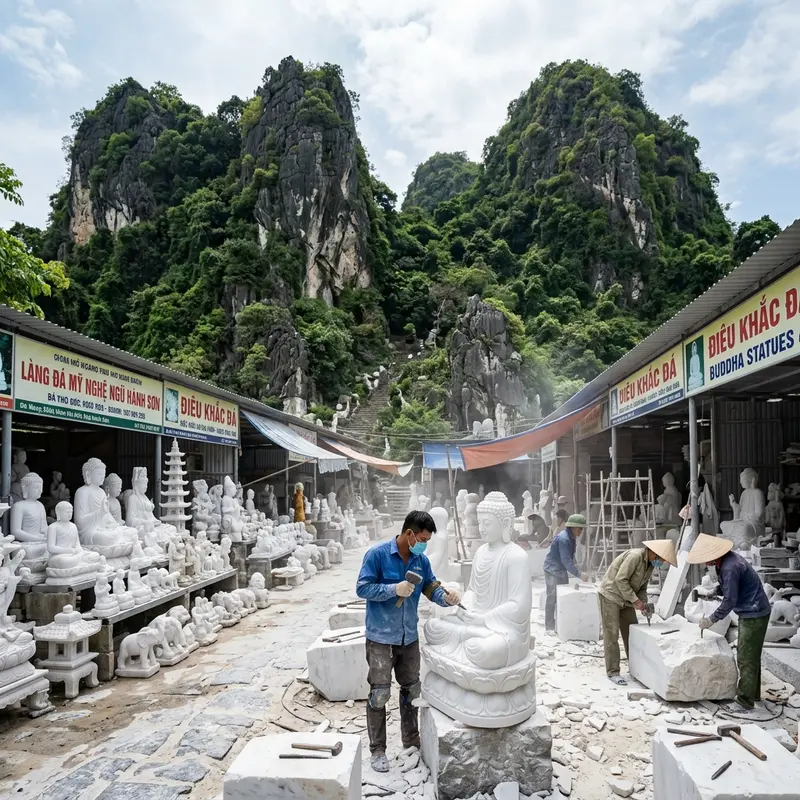
This is a place I find many tourists unfortunately overlook. Right at the foot of Marble Mountains is the Non Nuoc fine art stone carving village – one of the oldest and most famous craft villages in Vietnam, recognized by UNESCO is recognized as Intangible Cultural Heritage.
Hundreds of sculpting establishments line Huyen Tran Cong Chua street, with skilled artisans carving marble artworks. You can watch them work, chat, and of course, buy souvenirs.
[!WARNING] When buying souvenirs at Non Nuoc Stone Village, be careful to distinguish real marble from plastic/plaster painted to look like stone. The simplest way: real stone will feel cool to the touch (even on a hot day), be significantly heavier for its size, and produce a clear ringing sound when tapped lightly. Plastic or plaster items will feel warmer and have a duller sound. It’s recommended to buy from establishments with clear signage and specific addresses, rather than from street vendors around the entrance.
Estimated Costs for Visiting Ngu Hanh Son
Table
Frequently Asked Questions
Frequently asked questions about Marble Mountains Climbing Tips
What is the best way to use this guide to Marble Mountains Climbing Tips: Huyen Khong Cave?
Is Marble Mountains Climbing Tips: Huyen Khong Cave suitable for a first-time visitor?
Can I combine Marble Mountains Climbing Tips: Huyen Khong Cave with other nearby plans?
What should I confirm before making plans for Marble Mountains Climbing Tips: Huyen Khong Cave?
How can I avoid last-minute problems with Marble Mountains Climbing Tips: Huyen Khong Cave?
Tags
The Faifo Express
This article was written by the driver and travel consultant team at Faifo Express — over 5 years of experience in travel transport across Da Nang, Hoi An, and Hue. All information is based on real experience serving 5,000+ customers every month.
Related services
Airport Transfer
Hotel pickup, all-inclusive price
View DetailsDay Tour Car Rental
Ba Na Hills, Hoi An, My Son...
View DetailsShared Car
From just 100K VND/person
View DetailsTourist Car Rental
Explore the beauty of Central Vietnam with our private tourist car service.
View Details🛣️ Popular Routes

Follow Faifo Express
Get exclusive deals, real reviews and the latest Central Vietnam travel tips.
Faifo Express
Updates, customer reviews & real trip photos.
@trm.anh.travel
Real experience videos, Da Nang – Hoi An travel tips.
@xedichvudananghoianhue
Real videos of routes, fleet and transfer services.
@xedananghoianFE
Quick news, flash deals and direct interaction.
DM us on Facebook — response within 5 minutes