


Visiting Hue's Imperial City: Tickets, Timing and What Not to Miss
📋 Table of Contents
Hue Imperial City – Where History Touches Every Ancient Brick
I visited Hue Imperial City one morning at 7:30 AM, when mist still lingered on the surface of the Thai Dich Lake and the early morning sun hadn’t yet pierced through the canopy of hundred-year-old trees. At that moment, I was almost alone standing before the Ngo Mon Gate – the legendary gateway that witnessed King Bao Dai hand over the royal seal and sword, officially ending Vietnam’s last feudal dynasty. The feeling was indescribable: solemn, wistful, and awe-inspiring before the vast sweep of history unfolding before my eyes. If you are planning your Hue Imperial City visit experience, this article will be your true companion – not a photocopy from a tourist brochure, but the whisper of someone who has walked, sat, and breathed in this space dozens of times.
What is Hue Imperial City? Why is it Different from Any Other Monument in Vietnam?
200 Years of the Nguyen Dynasty Contained Within One Complex
Hue Imperial City – also known as the Imperial City of Hue – was the center of power for the Nguyen Dynasty, Vietnam’s last feudal dynasty, which reigned from 1802 to 1945. The entire complex is situated within the Hue Citadel, surrounded by a 2.5-meter-thick wall and a vast moat. The Imperial City covers an area of approximately 37.5 hectares, and within it lies the Forbidden Purple City – a place where only the emperor, his concubines, and a select few officials were permitted to enter.
What makes the Imperial City completely different from other historical sites in Vietnam is its scale and the depth of its architectural system. It’s not a temple, not a single building, but an entire miniature city with hundreds of structures: palaces, pavilions, temples, lakes, royal gardens, royal theaters… Every brick, every roof finial, every wall carries the imprint of a bygone era.
In 1993, the Complex of Hue Monuments was recognized by UNESCO as a World Cultural Heritage site. This is not a ceremonial title – it is an acknowledgment that Hue preserves one of humanity’s most important architectural and cultural treasures.
Numbers You Need to Know Before You Go
- Area of the Imperial City: 37.5 hectares
- Number of original architectural structures: Over 100 structures (many were destroyed in the war and are currently being restored)
- Number of main gates: 4 gates (Ngo Mon – South, Hoa Binh – North, Hien Nhan – East, Chuong Duc – West)
- Initial construction period: 1804 – 1833
- Number of Nguyen emperors: 13 reigns
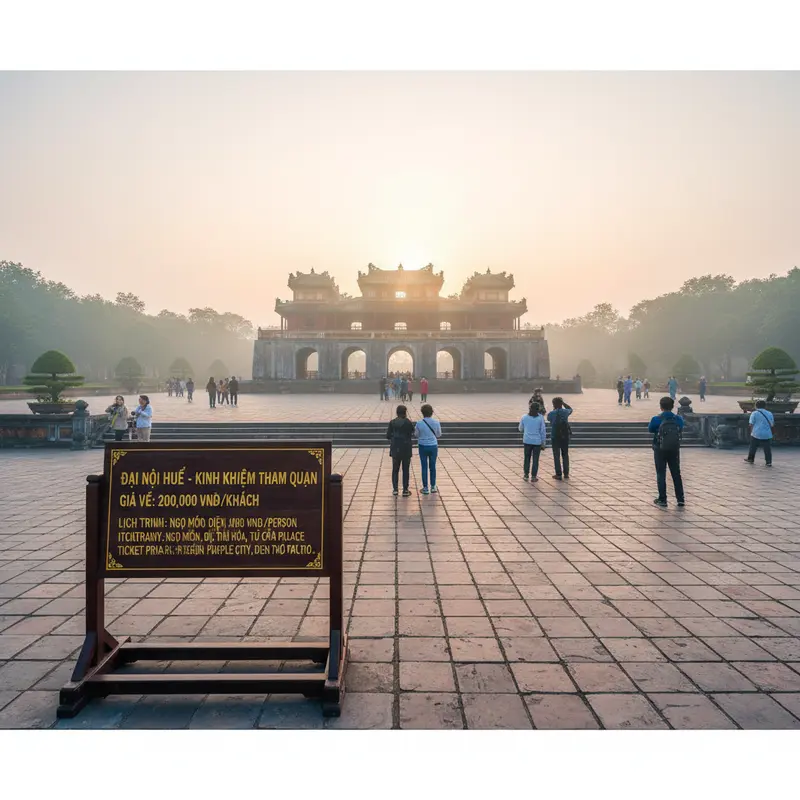
Hue Imperial City Ticket Prices 2024 – 2025: Everything You Need to Know
Official Ticket Prices
This is the information most people search for and also the most easily confused, as ticket prices change annually and vary by visiting area. As of the time this article was updated:
Hue Imperial City (Imperial City) Entrance Ticket:
- Adults: 240,000 VND (≈$9)/person
- Children aged 7–12: 50,000 VND (≈$2)/person
- Children under 7: Free
- Seniors (over 60, with ID card): Free
- People with disabilities: Free
Multi-site Combo Tickets (more economical):
The Center for Preservation of Hue Monuments offers combo tickets that allow access to multiple heritage sites on your Hue journey:
[!NOTE] Pricing Note for International Tourists The prices listed are inclusive of a 20% tax and service fee applied to foreign tourists. Estimated USD rates are based on current exchange rates and may slightly vary.
| Combo | Visiting Sites | Adult Price |
|---|---|---|
| Combo 2 Sites | Imperial City + 1 Tomb | 430,000 VND (≈$17) |
| Combo 3 Sites | Imperial City + 2 Tombs | 640,000 VND (≈$25) |
[!TIP] If you plan to visit multiple historical sites in Hue (Tu Duc Tomb, Khai Dinh Tomb, Minh Mang Tomb, Thien Mu Pagoda…), purchase the 5-point combo ticket from the start. Compared to buying individual tickets, you can save approximately 200,000 – 360,000 VND (≈$14). The combo ticket is valid for 2 consecutive days, offering great flexibility.
Where to Buy Tickets? Online or On-site?
You can purchase tickets at the ticket counter right at the Ngo Mon Gate – this is the most common method. However, during peak season (April, September, Tet holidays), the queue to buy tickets can be 20–30 minutes long.
Currently, the Hue Monuments Conservation Center supports online ticket purchases through their official website or app. I recommend buying online in advance to save time, especially if you are traveling in a large group.
[!WARNING] Absolutely do not buy tickets from street vendors or touts outside the gate. There have been many cases where tourists bought counterfeit tickets or were overpriced double the price. Only purchase tickets at official counters bearing the Hue Monuments Conservation Center’s signage.
Guide to Traveling to Hue Imperial City: Don’t Let Transportation Ruin Your Visit
From Da Nang to Hue – The Smartest Choice
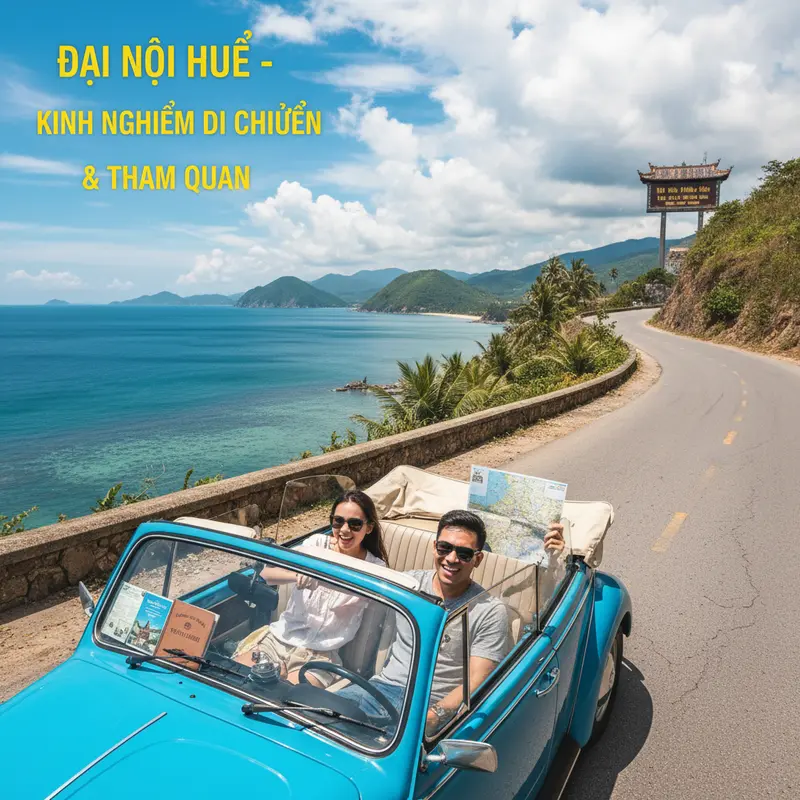
The distance from Da Nang to Hue is about 100km via National Highway 1A or the expressway, taking approximately 2 – 2.5 hours of travel. This is a route I’ve taken no less than 20 times, and each time I discover something new along the legendary Hai Van Pass.
If you are in Da Nang or Hoi An and want to visit Hue Imperial City, here are a few options:
1. Train: The Da Nang – Hue line passes through Hai Van Pass, offering beautiful scenery but taking more time (1.5 – 2 hours) and lacking schedule flexibility.
2. Bus: Cheap but with fixed schedules, no stops on demand, not suitable if you want to visit additional attractions along the way.
3. Rent a private car with a driver: This is the option I always recommend to friends and family. Especially if you are in Da Nang, the Da Nang – Hue car transfer service by Faifo Express is a top choice to consider.
Why Choose Faifo Express Over Taxi or Grab?
I understand many of you are accustomed to using Grab for convenience. However, for a long journey like Da Nang – Hue (100km), or Hoi An – Hue, Grab is not the optimal choice for several practical reasons:
- Grab prices for long distances are often unstable, potentially incurring extra charges for traffic jams, tolls, and peak hour surcharges.
- Grab drivers are not always locally knowledgeable – especially for stops off the main route.
- There is no 24/7 support service if issues arise en route.
Faifo Express is different: it is a professional, fixed-price, pre-booked transfer service, with a team of local drivers who are familiar with every road and every attraction along the Da Nang – Hoi An – Hue route. Drivers can advise you on stops to admire Hai Van Pass, Hai Van Tunnel, or visit Lang Co – places you would completely miss if traveling by train or bus.
Furthermore, if you’ve just landed at Da Nang Airport and want to go directly to Hue, Faifo Express’s Da Nang Airport transfer service also supports direct routes, no transfers needed, and no worries about bulky luggage.
[!TIP] Book your Faifo Express car at least 1 day in advance to ensure timely pickup and the appropriate vehicle type for your group size. They offer a range of vehicles from 4-seaters to 16-seaters, suitable for families and large groups of friends.
Getting Around Hue City to Imperial City
If you are already in Hue,Okay, the Imperial City is located right in the city center, just 1–3km from most hotels in the ancient town area. Local transportation options include:
- Bicycle Rental: 50,000 – 100,000 VND (≈$4)/day. This is my favorite way to explore Hue. Cycling along the Huong River in the early morning is an unforgettable experience.
- Cyclo: Approximately 50,000 – 120,000 VND (≈$5)/ride depending on the distance. Remember to negotiate the price beforehand.
- Grab/Taxi: Convenient, around 30,000 – 70,000 VND (≈$3) from the city center.
Detailed Itinerary for Visiting Hue Imperial City by Area
Starting from Ngo Mon – The Gate of History
Every visit to the Imperial City begins at Ngo Mon – the main southern gate of the Royal Citadel. This is the most impressive architectural work and the symbol of Hue Imperial City. Ngo Mon was built in 1833 during the reign of Emperor Minh Mang, consisting of two parts: a brick base and the Ngu Phung Tower above with 100 lacquered wooden columns.
What few people know: Ngo Mon has 5 gates, but only the central gate was exclusively for the emperor, the two adjacent gates were for mandarins, and the outermost two were for soldiers and horses. Today, visitors pass through the side gates – a small detail that speaks volumes about the strict hierarchical system of the Nguyen Dynasty.
Thai Hoa Palace – The Heart of the Royal Palace
Passing through Ngo Mon, crossing Trung Dao Bridge over Thai Dich Lake, you will reach the Great Court and Thai Hoa Palace – the place where the emperor held court and organized the most important ceremonies of the dynasty.
Thai Hoa Palace is one of the best-preserved structures within the Imperial City. Inside the palace, the restored Throne is placed solemnly in the center. The lacquered wooden columns gilded with gold, the intricate dragon and phoenix motifs on the roof, and the characteristic royal yellow create a space that is both majestic and splendid.
[!NOTE] Photography with flash is not allowed inside Thai Hoa Palace, and touching the artifacts is prohibited. Please respect these regulations to preserve the heritage for future generations.
Forbidden Purple City – The Forbidden Zone of the Nguyen Dynasty
Behind Thai Hoa Palace lies the Forbidden Purple City – the private living area of the royal family, where only the emperor, empress, concubines, and eunuchs were allowed. This area suffered the most damage during the war and is currently undergoing gradual restoration.
Within the Forbidden Purple City, don’t miss:
- Can Chanh Palace: Where the emperor worked daily (under restoration)
- Kien Trung Palace: Where the last Nguyen emperors lived, blending unique French-Vietnamese architecture
- Luc Vien: The living quarters of the concubines
- Thai Binh Lau: Emperor Khai Dinh’s private library
The Temple of Generations and the Nine Dynastic Urns – Where Kings are Worshipped
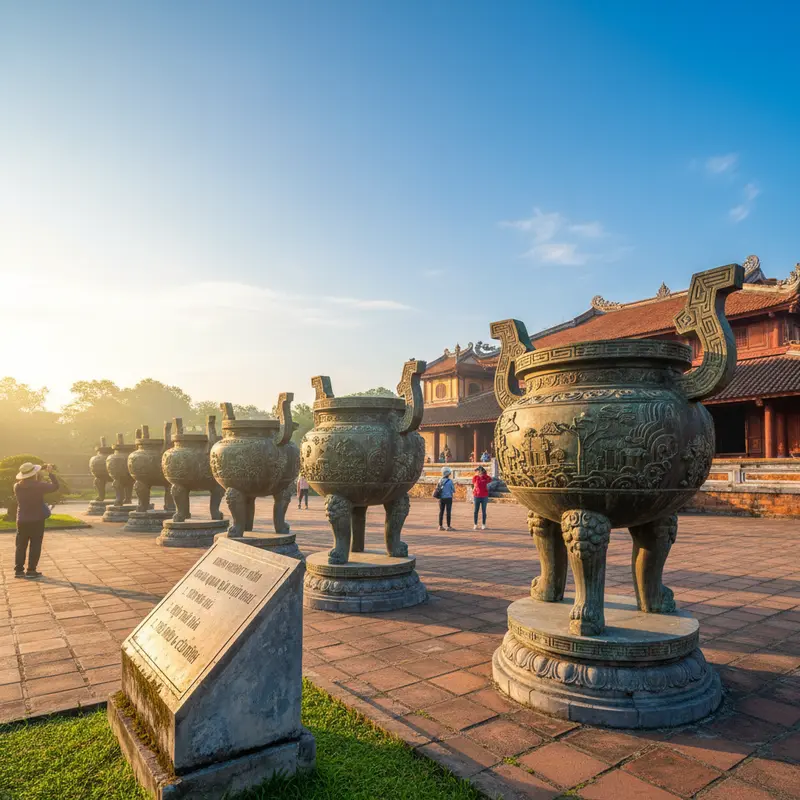
The Temple of Generations (The Mieu) is where the Nguyen Dynasty kings are worshipped, built in 1821. In front of The Mieu are the Nine Dynastic Urns – 9 giant bronze urns, each named after a king and engraved with characteristic images of the country: mountains, rivers, trees, animals, weapons… This is the largest and most exquisite bronze casting collection remaining in Vietnam, cast between 1835 and 1837.
Standing before the Nine Dynastic Urns, I always spend at least 15–20 minutes observing each engraved detail. Each image on the urns is an encyclopedia of the geography, culture, and products of Vietnam in the 19th century.
Long An Palace and the Hue Royal Antiquities Museum
Long An Palace (now the Hue Royal Antiquities Museum) is a must-visit if you want to deeply understandmore about the imperial court’s life. The museum houses thousands of precious artifacts: imperial porcelain, royal costumes, weapons, court musical instruments, jewelry…
Notably, the dragon robes (king’s robes) and phoenix robes (queen’s robes) displayed here are extremely rare artifacts, showcasing the peak of ancient Hue craftsmanship.
Co Ha Garden and Green Spaces Within the Imperial City
Few visitors know that inside the Imperial City lie incredibly quiet and beautiful gardens. Co Ha Garden, with its centuries-old trees, crystal-clear water, and cool air, is where I often rest during my tours. It’s also a lesser-known but extremely poetic check-in spot, especially when the water lilies are in bloom.
Real Experiences at the Imperial City of Hue: How to Make Your Trip More Memorable
Renting Traditional Costumes – An Experience of “Transforming” into the Past
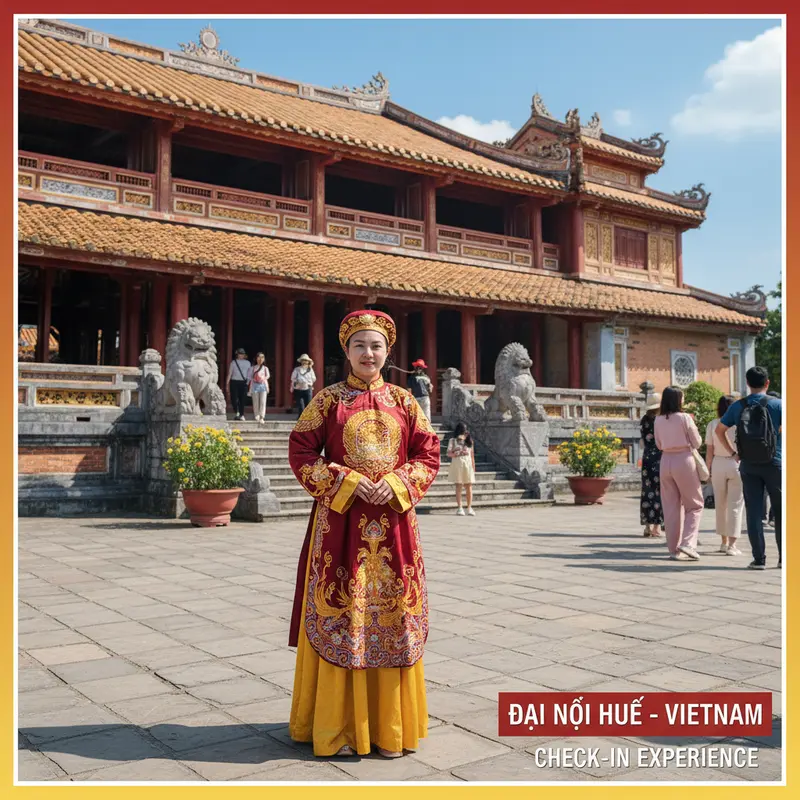
One of the most popular experiences at the Imperial City is renting traditional costumes for photoshoots. You can rent them at many spots inside or near the gates of the Imperial City for around 100,000 – 240,000 VND (≈$9)/set (including accessories like hats, fans, and shoes).
There are various types of costumes: the five-panel robes of mandarins, the dragon robes of the king (tourist version), the court long dresses of concubines… Wearing traditional costumes and taking photos in front of the Ngo Mon Gate, Thai Hoa Palace, or under the ancient trees in the garden – these are the photos you’ll cherish forever.
Enjoying Hue Royal Court Music Performances
Hue Royal Court Music is a UNESCO Intangible Cultural Heritage, and you can enjoy it right at the Imperial City. Performances are usually held at Duyet Thi Duong, the oldest royal theater in Southeast Asia, built in 1826.
Performance schedules are typically in the morning (around 9:00 – 10:00 AM) and afternoon (2:00 – 3:00 PM), but check the specific schedule at the information desk as it may vary by season. Performance tickets are usually included in the Imperial City entrance fee.
Must-Visit Photo Spots
After many visits to the Imperial City, here are the photo spots I highly recommend:
- Trung Dao Bridge reflected on Thai Dich Lake: Shoot in the early morning when the lake surface is as still as a mirror.
- View from the Five-Phoenix Tower down to the Dai Trieu Nghi courtyard: An elevated perspective, clearly showing the symmetrical layout of the Imperial City.
- Ta Vu – Huu Vu corridors: Long corridors with red wooden pillars, where light filters through to create beautiful lighting effects.
- Co Ha Garden: A photo spot under ancient trees with a crystal-clear lake.
- Hien Nhan Gate: Little-known, rarely photographed, but with incredibly impressive architecture.
What to Eat Around the Imperial City of Hue?
Hue Cuisine – Refined Down to Every Humble Dish
Hue is famous for its rich and refined cuisine. The area around the Imperial City and the Perfume River has many delicious eateries. After a tiring visit, here are some practical suggestions:
Breakfast before entering the Imperial City:
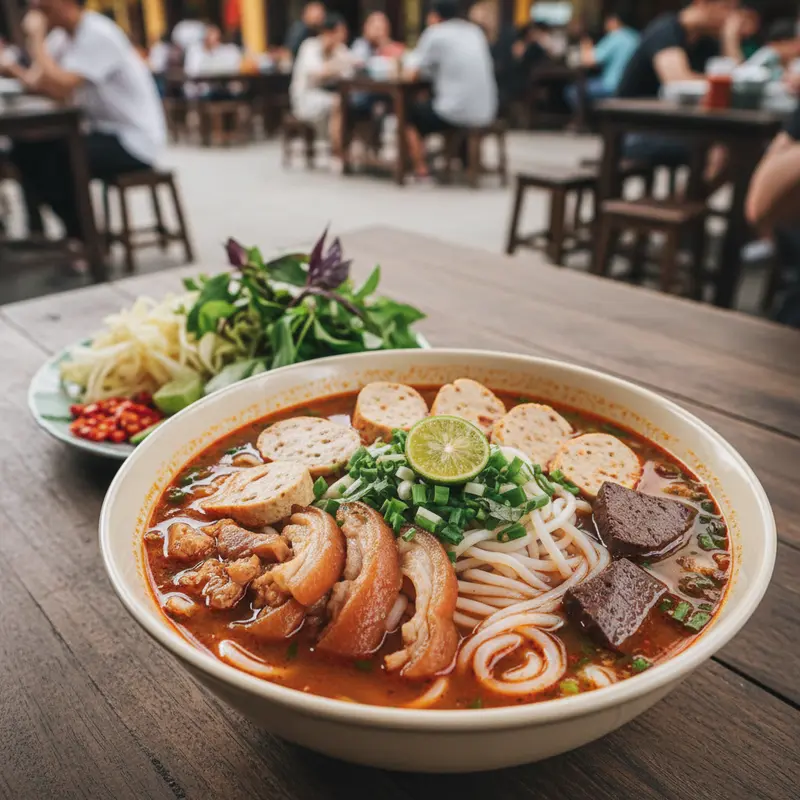
- Bun Bo Hue: A true Hue bowl of bun bo must have pork knuckle, blood pudding, crab cakes, and a dark red, spicy broth. O Xuan Bun Bo on Nguyen Chi Thanh street is my usual spot, costing around 40,000 – 70,000 VND (≈$3) per bowl.
- Banh Mi Hue: Completely different fromSaigon banh mi, Hue banh mi is smaller, crispier, and typically filled with Hue sausage and a distinctive chili sauce.
Lunch after sightseeing:
- Com hen: A purely Hue specialty with stir-fried clams, vermicelli, various herbs, and chili. Ba Cu Com Hen restaurant on Con Hen island (about 2km from the Imperial City) is the most authentic spot.
- Banh canh ca loc: A clear, sweet broth with fresh snakehead fish and smooth rice flour noodles.
- Nem lui: Grilled pork skewers wrapped in rice paper with fresh vegetables, cha
Frequently Asked Questions
Frequently asked questions about Hue Imperial City
What is the best way to use this guide to Hue Imperial City: Travel Tips, Tickets & Itinerary?
Is Hue Imperial City: Travel Tips, Tickets & Itinerary suitable for a first-time visitor?
Can I combine Hue Imperial City: Travel Tips, Tickets & Itinerary with other nearby plans?
What should I confirm before making plans for Hue Imperial City: Travel Tips, Tickets & Itinerary?
How can I avoid last-minute problems with Hue Imperial City: Travel Tips, Tickets & Itinerary?
Tags
The Faifo Express
This article was written by the driver and travel consultant team at Faifo Express — over 5 years of experience in travel transport across Da Nang, Hoi An, and Hue. All information is based on real experience serving 5,000+ customers every month.
Related services
Airport Transfer
Hotel pickup, all-inclusive price
View DetailsDay Tour Car Rental
Ba Na Hills, Hoi An, My Son...
View DetailsShared Car
From just 100K VND/person
View DetailsTourist Car Rental
Explore the beauty of Central Vietnam with our private tourist car service.
View Details🛣️ Popular Routes
Follow Faifo Express
Get exclusive deals, real reviews and the latest Central Vietnam travel tips.
Faifo Express
Updates, customer reviews & real trip photos.
@trm.anh.travel
Real experience videos, Da Nang – Hoi An travel tips.
@xedichvudananghoianhue
Real videos of routes, fleet and transfer services.
@xedananghoianFE
Quick news, flash deals and direct interaction.
DM us on Facebook — response within 5 minutes