


A Morning as a Farmer in Tra Que Vegetable Village
📋 Table of Contents
When the Earth Breathes, When Hands Touch Mud – A Day as a Farmer at Tra Que Vegetable Village, Hoi An
One morning, I woke up at 5:30 AM, not to an alarm, but to the crowing of roosters echoing through the window of my guesthouse in Hoi An. Outside, mist still veiled the moss-covered tiled roofs, and I knew – today would be a day entirely different from all the trips I had ever taken. Today, I wouldn’t be sightseeing, admiring scenery, or taking selfies in front of lanterns. Today, I would be a farmer at Tra Que Vegetable Village in Hoi An – one of the most authentic and memorable agricultural tourism experiences this Central Vietnamese land has to offer anyone brave enough to put down their phone and bow down to the earth.
If you’re looking for something beyond the loop of the ancient town – coffee – lanterns, then this article is for you. I will recount the entire journey, from how to get there, what actually happened during the farming experience, to the little secrets that only long-time residents know.
What is Tra Que Vegetable Village? Its History and Little-Known Beauty
A Land with a Soul for Over 400 Years
Tra Que Vegetable Village is located about 3 km northeast of Hoi An Ancient Town, in Cam Ha commune, Hoi An city, Quang Nam province. It sounds close, but when you set foot here, you’ll feel like you’ve stepped into a completely different dimension – where time slows down, the air smells of basil and aromatic herbs, and the rhythmic sound of hoeing the soil is like the village’s breath.
According to the elders in the village, Tra Que was established in the 17th century, linked to the prosperity of Hoi An trading port. As Japanese, Chinese, and Portuguese merchants flocked here for trade, the demand for fresh vegetables and herbs for meals increased. This spurred the residents of Tra Que to focus on cultivation, gradually forming a renowned vegetable farming village throughout the region.
What makes Tra Que vegetables special is not only the traditional farming techniques but also the water and river weeds. The villagers use weeds from the De Vong River – a small river flowing through the village – to fertilize the soil. These weeds are rich in natural minerals, making the soil loose and the vegetables grow well without the need for chemical fertilizers. That’s why Tra Que vegetables have a richer, more fragrant flavor than industrially grown vegetables.
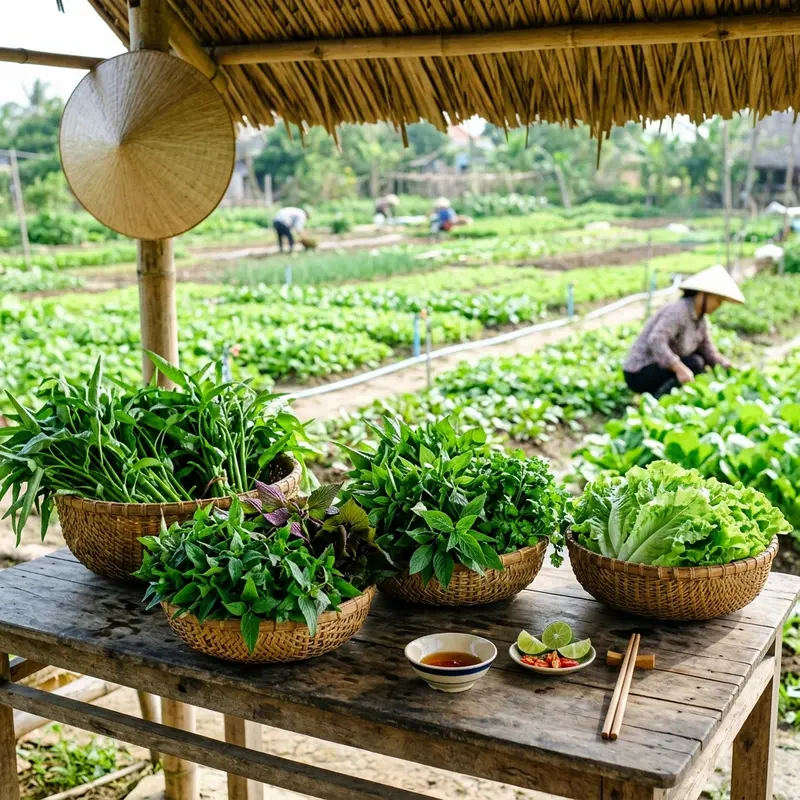
Today, the village has about over 200 households specializing in vegetable cultivation. The most characteristic vegetables include: basil, water spinach, mustard greens, lettuce, culantro, perilla, perilla mint, Vietnamese coriander, spring onions… And notably, vegetables from Tra Que are an indispensable ingredient in Hoi An’s famous dishes like Cao Lau, Mi Quang, and Banh Mi Phuong.
The Beauty of Tra Que – Not in Grandeur
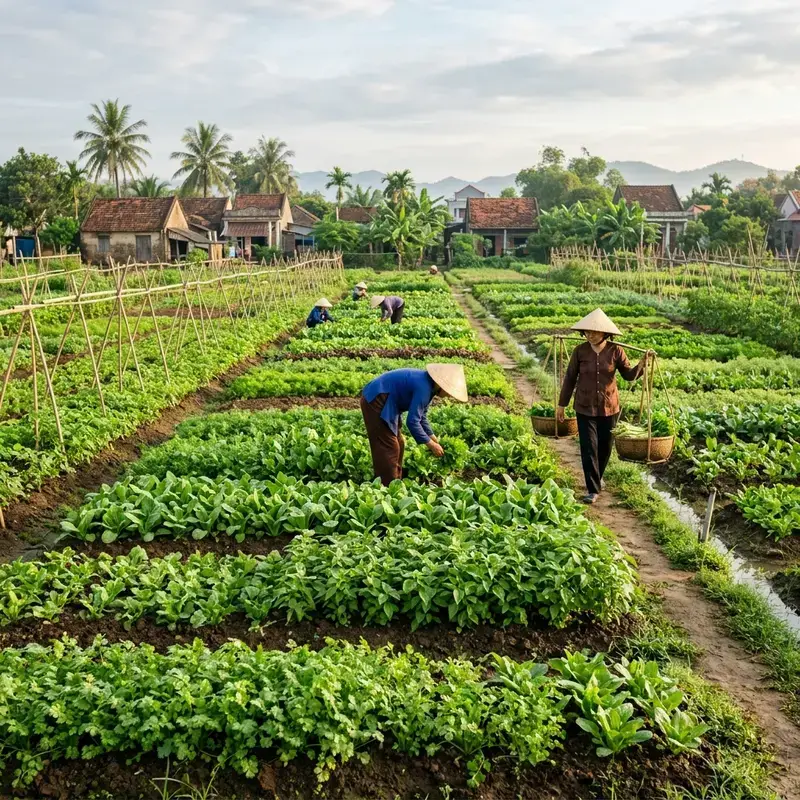
If you expect a magnificent or vibrantly colorful scene, Tra Que might surprise you at first. The beauty here is the beauty of simplicity and authenticity – lush green vegetable rows stretching as far as the eye can see under a blue sky, farmers in conical hats bowing to water the plants, the rhythmic splashing sound of buckets scooping river weeds to fertilize the soil.
Early morning, around 6-7 AM, is the most beautiful time. The soft golden light of the rising sun shines through the rows of vegetables, morning dew still clings to every leaf, and the whole village is starting its workday – this is a picture I can guarantee you won’t find in any photo studio.
How to Get to Tra Que Vegetable Village – Don’t Get “Ripped Off” Right From the Start
From Da Nang to Hoi An, Then to Tra Que
This is where many tourists, especially first-time visitors to Hoi An, get confused and end up overpaying. Let me be completely frank.
From Da Nang Airport, if you take a traditional taxi or Grab to Hoi An, the price ranges from 250,000 – 420,000 VND (≈$16) depending on the time and company. However, it’s not uncommon for tourists to be taken on detours by drivers, who may claim to be unfamiliar with the route or intentionally stop at places where you’re pressured to buy souvenirs.
The solution I always recommend to friends and acquaintances visiting here is to use the Da Nang Airport to Hoi An shuttle service by Faifo Express – a local tourism transport company that I’ve used many times and truly trust. The reasons are:
- Drivers are locals, who know the roads of Hoi An – Da Nang like the back of their hand, so they never take detours.
- Fixed, all-inclusive price, with no hidden fees, even in traffic jams or during waiting times.
- Clean, air-conditioned vehicles, suitable for large families as well as couples.
- Advance booking is available, which is very convenient if you have an early morning or late night flight.
[!TIP] If you’re planning your entire trip to Da Nang – Hoi An – Hue, consider Faifo Express’s car rental service to Hoi An and car service to Ba Na Hills for a seamless journey without the hassle of finding transportation for each leg.
From Hoi An Ancient Town to Tra Que Vegetable Village
Once you’re in Hoi An Ancient Town, you can get to Tra Que in several ways:
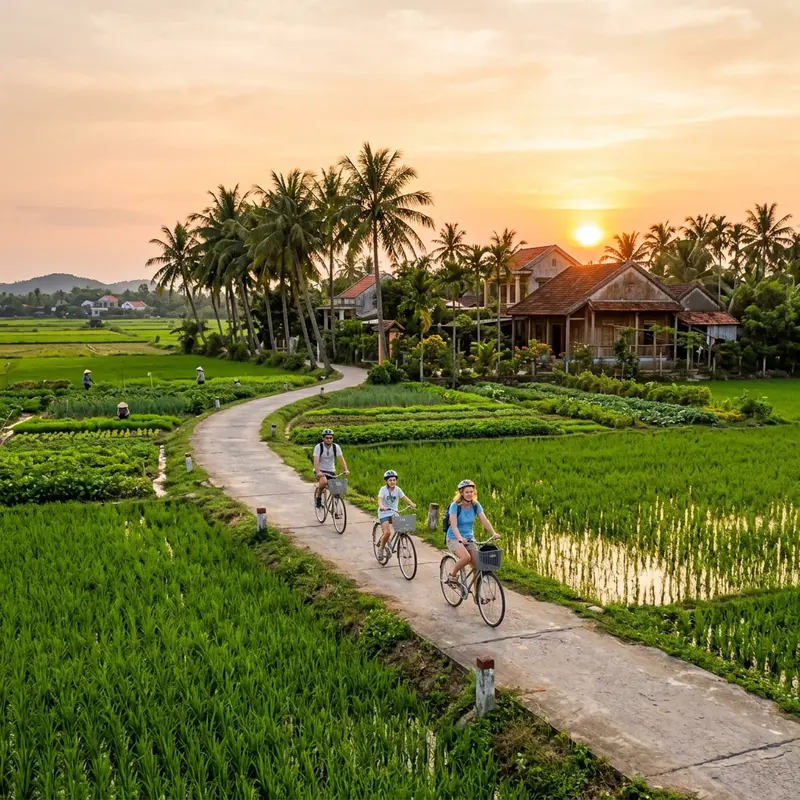
1. Bicycle (Highly Recommended): This is the most “authentic” way to enjoy the journey. You can rent bicycles at most guesthouses/hotels in the ancient town for 20,000 – 40,000 VND (≈$2)/day. The road from the ancient town to Tra Que is flat, with little traffic, shaded by trees, and takes about 15-20 minutes. This is an experience I believe you shouldn’t miss.
2. Motorbike: If you’re comfortable riding a motorbike, you can rent one for 80,000 – 140,000 VND (≈$5)/day. Note: Hoi An has regulations restricting motorbikes in the ancient town during certain hours, so ask your rental place for details.
3. Village Electric Cart: Some all-inclusive tours will arrange electric carts to take you from the meeting point to the village. It’s convenient but less “authentic” than cycling.
[!WARNING] Avoid traditional cyclo drivers without meters in the ancient town area. Many tourists have been overpriced 3-4 times the actual fare. If you need flexible transportation for the whole day, Faifo Express’s package service remains the more economical and overall safer option.
Experiencing a Day as a Farmer in Tra Que – Hour by Hour, Minute by Minute
6:00 AM – When the Village Begins to Wake Up
I arrived at Tra Que a little after 6 AM. The air was cool, carrying the scent of damp earth and aromatic herbs mixed together. The first farmers were already in the fields since 5:30 AM – they seize the cooler morning hours before the sun gets higher and hotter.
The usual meeting point for visitors is Mr. Le Van Tam’s house or one of the few households registered for community-based tourism. You’ll be welcomed by a local guide – often one of the farmers from the village – with a cup of herbal tea brewed from the garden’s own herbs. This isn’t a tourist show – this is how the people of Tra Que have genuinely welcomed guests for generations.
6:30 AM – Learning How to Fertilize with Riverweed and Prepare the Soil
The first activity, and often the most surprising for many visitors, is scooping riverweed from the river to fertilize the soil.
Your guide will take you to the De Vong River bank, where thick green riverweed grows. You’ll be given a scoopto learn how to scoop seaweed, then carry (or haul) it back to the vegetable beds for fertilizing. It sounds simple at first, but it’s actually a technique that requires strength and dexterity – the seaweed bucket is much heavier than you’d think, and walking on slippery soil banks without falling is an art in itself.
I fell once. It didn’t hurt, but my pants got soaked. And the whole village (including another group of tourists) burst into laughter. It was one of the most memorable moments of my trip.
7:30 AM – Into the Fields: Sowing Seeds, Weeding, Watering
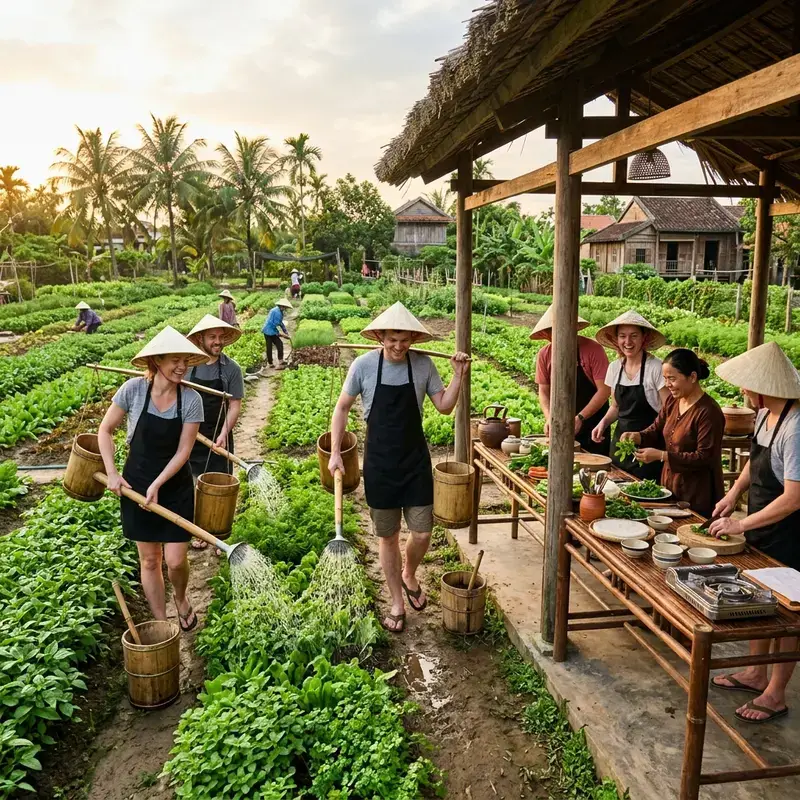
This is the core experience. You’ll be provided with conical hats, hoes, and sometimes rubber boots (if you don’t bring your own). The guide will teach you:
- How to prepare the soil: Hoeing the land with proper technique, creating straight rows. It sounds simple, but to hoe evenly and without back pain after 10 minutes is something not everyone can do.
- How to sow seeds: Each type of vegetable has a different sowing distance. Water spinach seeds are sown more sparsely than basil seeds. The farmers here do this instinctively, without a measuring tape.
- How to water with a bucket: It’s not just about pouring water. Watering correctly so that the water soaks in evenly without damaging newly sown seeds is a skill in itself.
- Weeding: This is the most time-consuming part and requires the most patience. You have to distinguish between weeds and young vegetable sprouts.
[!NOTE] Don’t worry if you have no agricultural experience. The guides are very patient and humorous. They have taught hundreds of tourists from all over the world, including those who have never held a hoe in their lives. This is a fun experience, not a test.
9:00 AM – Cooking and Enjoying Breakfast On-Site
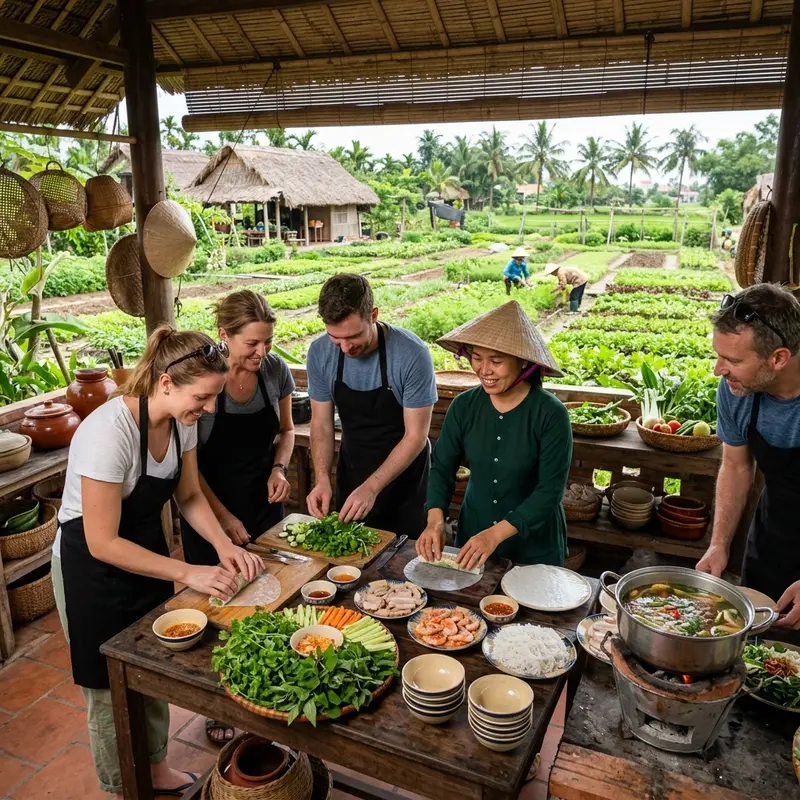
After about 2 hours of working in the fields, you’ll be invited into a local household’s kitchen to participate in cooking with the very vegetables you just harvested. This was my favorite part.
The menu usually includes:
- Stir-fried water spinach with garlic – simple but incredibly delicious when the vegetables are freshly picked from the garden
- Mixed vegetable soup – a rustic dish of Quang Nam people, cooked with various aromatic herbs
- White rice cooked over a wood fire – rice cooked over a traditional wood fire has a very distinctive light smoky aroma
- Sometimes fried tofu or braised fish with soy sauce is added
Sitting down to breakfast on a bamboo bed under the shade, looking out at the green vegetable beds you just tended – that feeling is something no restaurant in Hoi An can replicate.
10:00 AM – Visiting the Vegetable Garden and Learning to Identify Aromatic Herbs
After the meal, the guide will take you on a tour around the village, introducing you to each type of vegetable. This is where I learned the most.
For example, did you know that:
- Basil in Tra Que has smaller leaves and a stronger aroma than Southern basil because of the different soil and climate?
- Sawtooth coriander (also known as Vietnamese coriander) is an indispensable herb in a bowl of Hanoi Pho but is rarely used in Hoi An cuisine?
- Vietnamese mint grown here has a milder spiciness than Northern Vietnamese mint, making it more suitable for eating raw with seafood dishes?
The guide will let you smell and taste each type of herb right in the garden. This is a more practical and interesting culinary lesson than any cooking class.
11:00 AM – Cake Making Class (Optional)
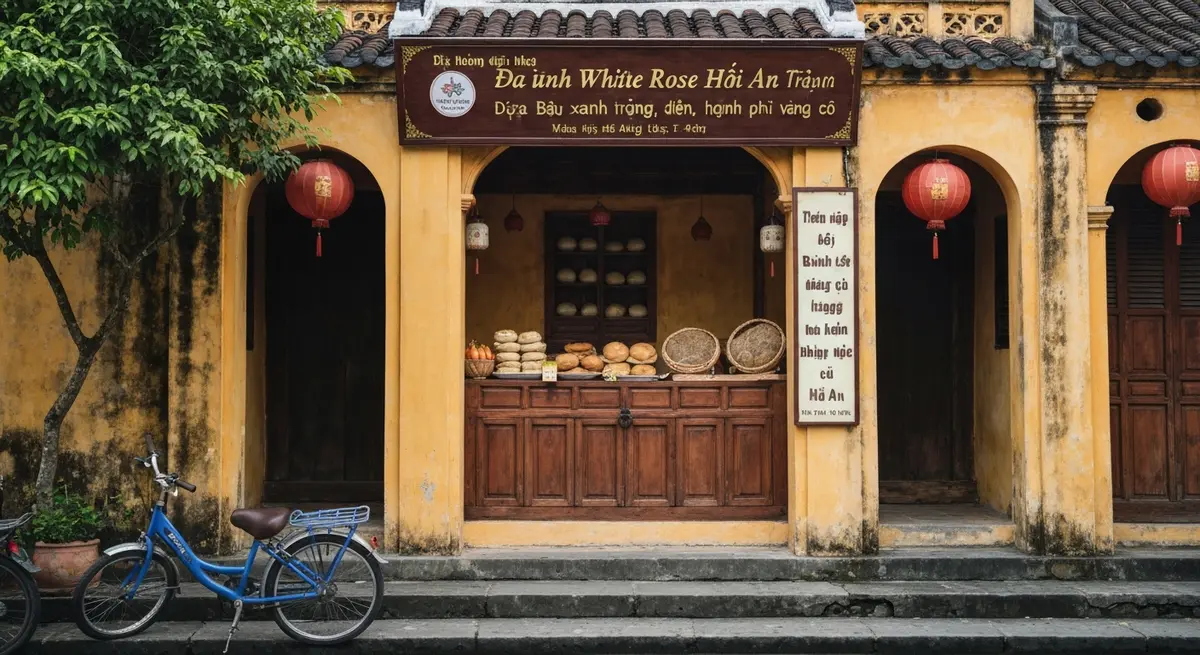
Some tours in Tra Que offer an additionalthe Hoi An folk cake making experience, such as white rose dumplings, steamed dumplings, or rice paper rolls with pork. This is an optional part that usually incurs an additional cost, but it’s well worth it if you want to delve deeper into the local cuisine.
Check-in Spots and Unforgettable Moments
The Most Beautiful Photo Opportunities in Tra Que
Although I mentioned this wasn’t a trip for selfies, Tra Que actually has many stunning photo spots that you’ll regret missing:
1. De Vong Riverbank at Dawn: The soft golden light reflecting on the river’s surface, the silhouette of farmers scooping up seaweed – this is the most beautiful photo you’ll get in Hoi An without any filters.
2. Vegetable Beds from Above: If you have a drone or a smartphone with a wide-angle lens, shoot from a high angle to capture the endless, perfectly straight rows of vegetables.
3. The Scene of Watering with a Gau (Bucket): The moment water pours from the bucket onto the vegetable beds, creating sparkling droplets in the morning sun – it’s incredibly photogenic.
4. The Wood-fired Stove and Rice Pot: Gentle smoke rising from the traditional kitchen – a photo spot with an incredibly beautiful nostalgic atmosphere.
5. Barefoot on the Earth: Try taking off your shoes and placing your bare feet on the freshly plowed soil – the feeling of cool earth touching the soles of your feet is a sensory experience I highly recommend.
Estimated Costs for a Day in Tra Que Vegetable Village
Detailed Cost Breakdown
This is the part where I want to be very specific so you won’t be surprised:
Entrance Fees and Farming Experience:
- Basic farming experience tour (2-3 hours, includes guidance, harvested vegetables, meal): 150,000 – 300,000 VND (≈$12)/person
- Advanced tour (includes cooking or cake-making class): 300,000 – 540,000 VND (≈$21)/person
- Children under 5 years old: Usually free
[!TIP] Booking tours through travel agencies or directly on the village’s website often results in prices 15-20% lower than booking through international tour apps. Also, inquire at your guesthouse/hotel – many have partnerships and can help you book at a discounted rate.
Transportation:
- Bicycle rental from the Ancient Town: 20,000 – 40,000 VND (≈$2)/day
- Airport shuttle Da Nang – Hoi An (Faifo Express): Contact directly for the best quote
- Grab/taxi from the Ancient Town to Tra Que (if not cycling): 40,000 – 70,000 VND (≈$3)/one-way trip
Food and Drinks:
- Meal at the village (usually included in the tour): Free or 50,000 – 100,000 VND (≈$4) if charged separately
- Lunch/dinner at eateries near the village: 50,000 – 120,000 VND (≈$5)/person
Shopping:
- Fresh vegetables to take home: 10,000 – 40,000 VND (≈$2)/bunch depending on the type
- Processed vegetable products (herbal tea, essential oils): 50,000 – 180,000 VND (≈$7)
Estimated total cost for one day in Tra Que (excluding transportation from Da Nang): approximately 300,000 – 720,000 VND (≈$28)/person, depending on tour choices and spending habits.
Practical Experience – Things Only Those Who Have Been Know
When is the Best Time to Visit?
Tra Que is beautiful year-round, but some times are more special:
February – April: This is the most beautiful season. The weather is cool, no rain, and the vegetables are lush and green. The morning light is perfect for photography.
May – August: It’s hotter, but still beautiful. It’s advisable to goWake up early (before 7 AM) to avoid the midday sun.
September – November: Rainy season in Hoi An. The road into the village may be muddy, and some areas may be flooded. However, this is when the landscape takes on a different, magical beauty. Remember to bring a raincoat and waterproof shoes.
December – January: Cool weather with light drizzle. Not the most ideal time, but still manageable if you prepare well.
What to Wear and Bring
Here’s a list I always suggest to friends before they visit Tra Que:
- Long pants or capris: Avoid very short shorts as you’ll be squatting and bending over a lot.
- Dark or old clothes: You WILL get dirty.
Frequently Asked Questions
Frequently asked questions about A Day as a Farmer in Tra Que Vegetable Village, Hoi An
What is the best way to use this guide to A Day as a Farmer in Tra Que Vegetable Village, Hoi An?
Is A Day as a Farmer in Tra Que Vegetable Village, Hoi An suitable for a first-time visitor?
Can I combine A Day as a Farmer in Tra Que Vegetable Village, Hoi An with other nearby plans?
What should I confirm before making plans for A Day as a Farmer in Tra Que Vegetable Village, Hoi An?
How can I avoid last-minute problems with A Day as a Farmer in Tra Que Vegetable Village, Hoi An?
Tags
The Faifo Express
This article was written by the driver and travel consultant team at Faifo Express — over 5 years of experience in travel transport across Da Nang, Hoi An, and Hue. All information is based on real experience serving 5,000+ customers every month.
Related services
Airport Transfer
Hotel pickup, all-inclusive price
View DetailsDay Tour Car Rental
Ba Na Hills, Hoi An, My Son...
View DetailsShared Car
From just 100K VND/person
View DetailsTourist Car Rental
Explore the beauty of Central Vietnam with our private tourist car service.
View Details🛣️ Popular Routes

Follow Faifo Express
Get exclusive deals, real reviews and the latest Central Vietnam travel tips.
Faifo Express
Updates, customer reviews & real trip photos.
@trm.anh.travel
Real experience videos, Da Nang – Hoi An travel tips.
@xedichvudananghoianhue
Real videos of routes, fleet and transfer services.
@xedananghoianFE
Quick news, flash deals and direct interaction.
DM us on Facebook — response within 5 minutes