


Hoi An's Traditional Festivals: When the Ancient Town Comes Fully Alive
📋 Table of Contents
There are some trips where, even after returning home, you can still hear the faint sound of lion drums and see the shimmering red lanterns reflecting on the Hoai River in the quiet night. That’s exactly what Hoi An does to me — and to millions of other visitors who have set foot in this ancient land. If you’re looking for must-visit traditional festivals in Hoi An, then congratulations: you’ve come to the right place.
I was born in Da Nang and grew up with weekend trips to Hoi An with my family. For me, Hoi An is more than just the ancient town or Phuong Banh Mi — it’s a living, breathing entity that beats strongest during festival days. Unlike many articles that just list festival names and stop there, in this piece, I’ll share what truly happens within, the hidden corners only frequent visitors know, and essential tips for you to experience it fully without feeling overwhelmed or ripped off.
Hoi An and Festival Culture: A Living Heritage Like No Other
Hoi An was recognized as a UNESCO World Heritage Site in 1999, but what truly sets this place apart isn’t its wooden houses or moss-covered tiled roofs — it’s how the people here live with that tradition every day. In many other places, festivals are organized as a tourist product. In Hoi An, festivals are the breath of the community.
What I always tell friends before they visit Hoi An for the first time: don’t just look, participate. The people of Hoi An have an unofficial saying that I heard from an elderly woman selling sweet soup on Tran Phu street: “Guests are not guests, guests are family.” This spirit is most evident during festival days, when the line between tourists and locals almost completely disappears.
Hoi An has a packed festival calendar year-round, from major international events like the Full Moon Lantern Festival, to smaller yet equally moving folk rituals like the Fishing Blessing Ceremony of the Cam Nam village fishermen. Each festival carries its own layer of meaning — about the history of the trading port, about the Vietnamese-Chinese-Japanese-French cultural exchange, and about the spiritual beliefs of the people who have been rooted here for centuries.
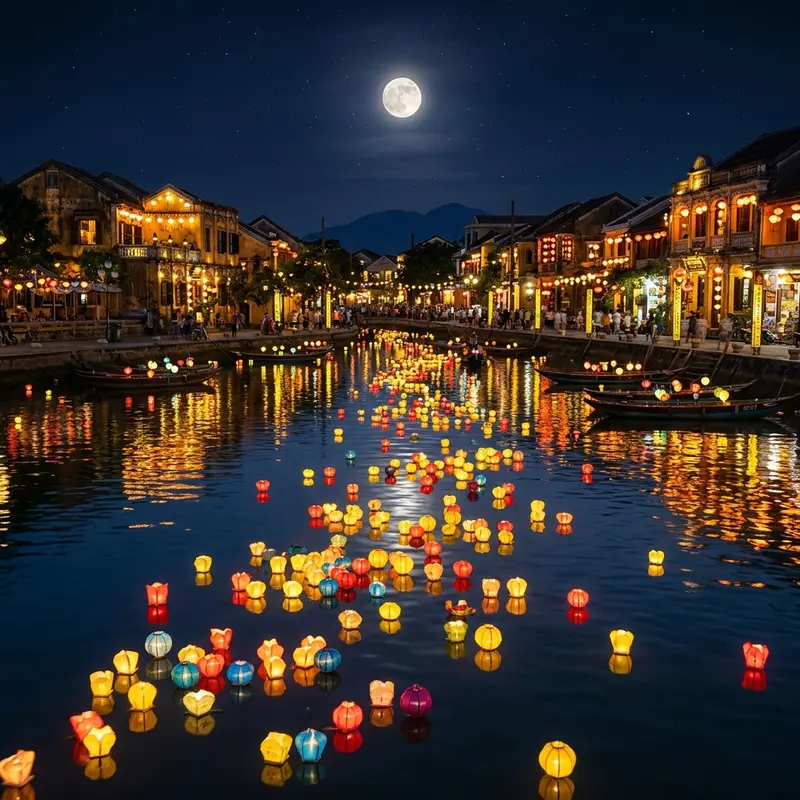
Full Moon Lantern Festival — The Heart of All Hoi An Festivals
If you can only choose one festival to experience in Hoi An, don’t hesitate: it’s the Full Moon Lantern Festival, held on the 14th night of every lunar month (often called “Old Town Night” or “Full Moon Night”).
History and Significance of the Full Moon Lantern Festival
This festival officially began to be organized in 1998, but the tradition of lighting lanterns and turning off electric lights on the full moon night has existed for hundreds of years, originating from the Chinese community who settled in Hoi An from the 17th century. The Chinese believe the full moon night is a time when yin and yang harmonize, and the round moon’s lightsymbolizing completeness and reunion. They light lanterns to guide ancestral spirits home for visits and to pray for family peace.
An interesting detail that few guidebooks mention: each lantern color in Hoi An carries a different meaning. Yellow lanterns symbolize luck and prosperity, red lanterns represent marital happiness, and green lanterns signify health and longevity. As you stroll through Tran Phu or Nguyen Thai Hoc streets on a full moon night, notice the color combinations of lanterns in front of each house—it’s how homeowners “speak” to their ancestors and deities without words.
What Actually Happens on a Full Moon Night
From around 6:30 PM, the entire electrical grid in the ancient town is turned off. This is a magical moment: darkness descends, and then thousands of lanterns begin to glow, transforming the ancient town into a vibrant oil painting. Traditional music echoes from communal houses and pagodas. People dressed in traditional ao dai take to the streets. The scent of incense wafts through the air.
On the Thu Bon River, hundreds of flower lanterns are released onto the water—a ritual locals call “releasing lanterns for peace.” You can buy these flower lanterns for 20,000-40,000 VND (≈$2) from vendors along the riverbank, but my advice is: don’t just buy and release them immediately. Sit by the riverbank, watch the tiny flame flicker on the water’s surface, and allow yourself a moment of true tranquility amidst the bustling crowd.
[!TIP] Want the best photo opportunities on Full Moon Night? Head to the Japanese Covered Bridge (Lai Vien Kieu) before 6 PM to “secure” your spot. Standing at the bridge’s entrance on the Nguyen Thi Minh Khai side, looking towards the river, you’ll get a perfect frame with lanterns on both sides and the river below. This is a popular angle among professional photographers but is rarely shared publicly.
Cultural Performances and Special Activities
Full Moon Night is not just about admiring lanterns. Small stages are scattered throughout the ancient town, showcasing “Ho hat bai choi”—a folk art form recently recognized by UNESCO as Intangible Cultural Heritage. Bai choi combines singing and card games. Players sit in bamboo huts, and the announcer (anh hieu) holds up cards and sings witty verses; whoever matches their card wins. This game is incredibly fun and interactive—visitors can fully participate without knowing Vietnamese, just by following the cues and laughing.
Additionally, there are lion dances, traditional martial arts performances, and handicraft stalls. Especially during months with larger festivals (like Tet Nguyen Dan or Mid-Autumn Festival), the program expands significantly with more performances.
The Lantern Festival — The Chinese New Year in the Heart of Hoi An
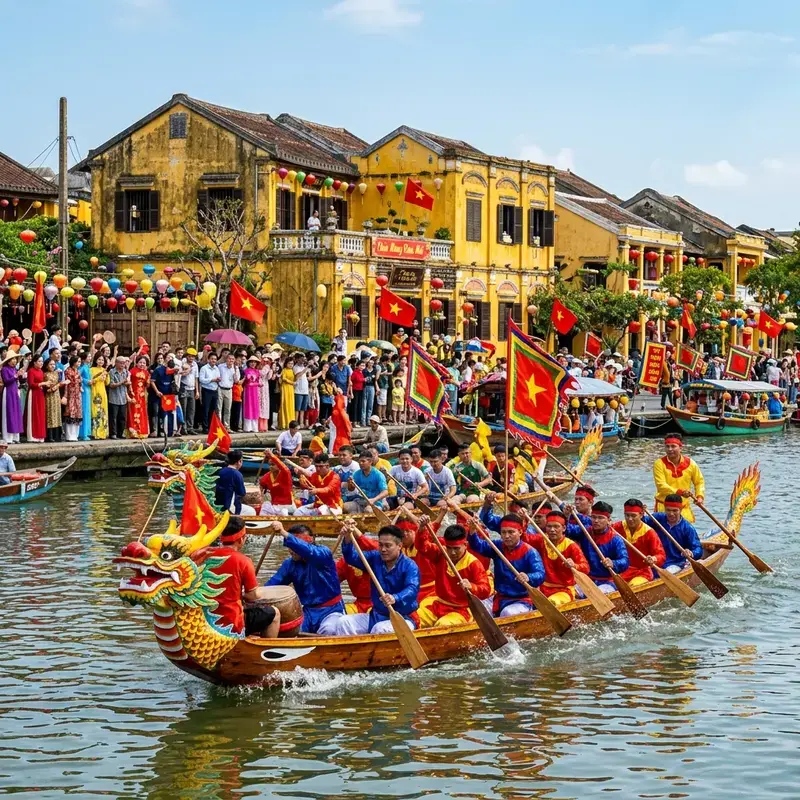
Few tourists know that Hoi An has a Chinese community (Minh Huong) that has lived here since the 17th century, and they still maintain their own unique New Year customs. Tet Nguyen Tieu (the 15th day of the first lunar month) is the biggest festival of the year for this community and one of the most distinctive traditional festivals you can experience in Hoi An.
Inside the Assembly Halls — Where Tradition is Preserved Intact
Hoi An has five Chinese assembly halls: Phuc Kien, Quang Dong, Trieu Chau, Hai Nam, and Ngu Bang. Each hall worships a different deity and has its own characteristic rituals. During Tet Nguyen Tieu, all of them open their doors from early morning, with fragrant incense smoke and the resounding echo of bells and drums.
What I always remember each time I visit the Phuc Kien Assembly Hall during this period is the image of elderly women, their silver hair tied up high, wearing deep purple ao dai, kneeling before the altar of Thien Hau Thanh Mau with absolute reverence. No explanation— that’s true faith, intact through generations. That moment made me understand why Hoi An is not just a living museum: it’s a place where history is still being written.
[!NOTE] When visiting assembly halls during festivals, dress modestly (avoid shorts and tank tops), walk and speak softly, and absolutely do not photograph people performing rituals without permission. Hoi An people are very hospitable but also deeply respect their spiritual space.
The Whale God Festival — The Sea Soul of Hoi An Fishermen
If you want to escape the crowds of the ancient town and experience a truly rustic Hoi An, head to the Whale God Festival in the fishing villages of Cam Nam, Cam Thanh, or Cu Lao Cham. This is a festival for fishermen, held annually in the first and seventh lunar months, praying for calm seas, abundant fish, and safety for those who go out to sea.
The Ritual of Procession and Ba Trao Singing
My favorite part of the Whale God Festival is the Ba Trao singing ritual — a unique folk art form found only in the central coastal region. The Ba Trao singing troupe consists of about 20-30 people, dressed in traditional fisherman attire, holding oars, singing and acting out scenes of going to sea, fishing, and braving storms. The lyrics are verses praising the sea, remembering lost fishermen, and praying for a bountiful catch.
Ba Trao is not a performance for an audience — it is a spiritual ritual, and you will feel it in the eyes of the participants: solemn, moved, sometimes even tearful. I once witnessed an old fisherman crying while singing Ba Trao, and when I asked, I learned he was singing for his son who was lost at sea the previous year. Moments like these cannot be bought with any tour.
The Whale God Procession — The Sacred Belief of Fishermen
Central Vietnamese fishermen worship the Whale God (whale) as a protective deity. When a whale dies and washes ashore, the locals hold a solemn funeral and bury it like a family member. After a certain period, the remains are exhumed and enshrined in the Whale God Temple. During the Whale God Festival, the palanquin carrying the Whale God’s remains is paraded around the village with a grand musical procession — this is the most solemn and moving part of the ceremony.
[!TIP] To witness the Whale God Festival in its true spirit, ask locals or hotel staff about the specific festival schedule for each village. The festival in Cam Thanh is usually larger and has more activities than in other villages. It’s advisable to arrive between 5-6 AM to not miss the palanquin procession at dawn — this is the most beautiful and least-known moment.
Hoi An Mid-Autumn Festival — Not Every Child Gets to See This
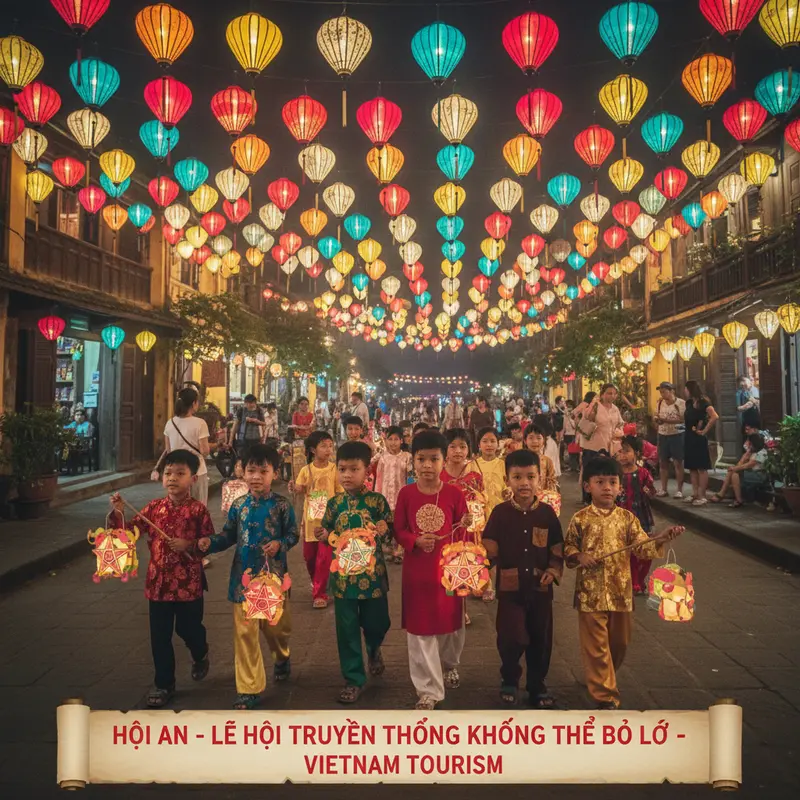
Mid-Autumn Festival is celebrated everywhere, but the Mid-Autumn Festival in Hoi An is a completely different experience. The ancient town of Hoi An on the 15th day of the eighth lunar month transforms into a true lantern paradise — not imported plastic lanterns, but traditional handmade silk lanterns, crafted by artisans who have been in the trade for generations.
The Lantern Making Village and the Secrets of the Craftsmen
Few people know that the lantern making craft in Hoi An is primarily concentrated in Cam P wardand some families on Tran Phu street. Each lantern is made entirely by hand: bent bamboo frame, silk or fabric covering, and decorative tassels. A skilled artisan takes about 2-3 hours to complete an average lantern.
During the Mid-Autumn Festival, many lantern-making workshops open their doors for visitors to tour and make lanterns themselves. This is an activity I highly recommend, especially if you are traveling with children. The prices range from 50,000-180,000 VND (≈$7) depending on the workshop, and you’ll bring home a lantern you made yourself—no souvenir is more meaningful than that.
Mid-Autumn Lantern Procession and Lion Dance Night
On the night of the full moon in August, children in Hoi An carry lanterns and parade through the ancient streets—a sight so beautiful it can bring tears to adults’ eyes. Lion dance troupes appear everywhere, with the sounds of drums and cymbals echoing through the streets. Adults sit in front of their houses, setting up moon-gazing trays with mooncakes, traditional pastries, and various fruits.
What’s special in Hoi An: many families still uphold the tradition of “pha co trong trang” (moon-gazing feast) in the traditional way—the whole family gathers in the yard, tells the stories of Chu Cuoi and Hang Nga to the children, and then eats cakes together under the moonlight. If you are lucky enough to be invited by a Hoi An family to join their feast, don’t refuse—it’s an experience you won’t find in any guidebook.
Tra Que Vegetable Village Festival and Traditional Agricultural Festivals
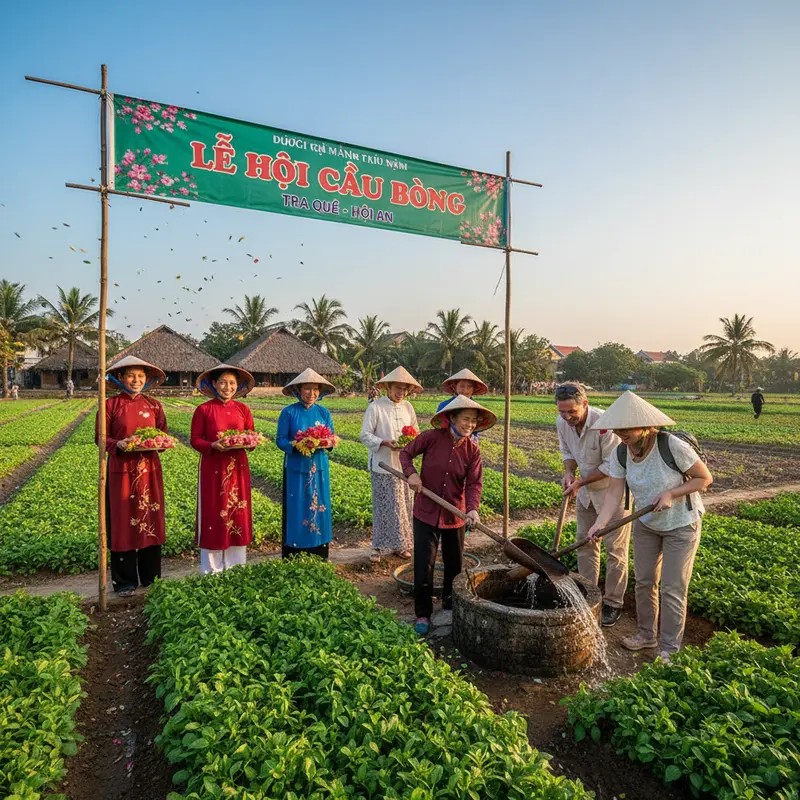
About 3km from Hoi An Ancient Town is Tra Que Vegetable Village, where people have been growing vegetables using traditional methods for hundreds of years. Every year, at the beginning of the new year, the village organizes the “Cau Bong” Festival—praying for a bountiful harvest and abundant vegetables.
”Farmer for a Day” Experience During the Festival
During the festival, visitors can join the locals: digging, sowing seeds, watering vegetables, and harvesting them using traditional methods. This isn’t a staged “experience tour”—this is real work, and you will sweat for real. In return, you’ll enjoy a lunch cooked with the vegetables you just picked, featuring simple dishes like water spinach soup, stir-fried garlic vegetables, and white rice cooked in an earthen pot.
[!NOTE] Tra Que Vegetable Village uses seaweed from the Thu Bon River as natural fertilizer—this is the secret to the unique flavor of Tra Que vegetables that cannot be found anywhere else. When you eat vegetables here, you’ll immediately notice the difference: they are crispier, more fragrant, and have a distinct natural sweetness.
How to Travel to Hoi An to Attend Festivals
This is the part where I want to be honest, no beating around the bush: traveling to Hoi An during festival days is a challenge. Especially on Full Moon nights, Lunar New Year, or the Mid-Autumn Festival, the number of people flocking to the ancient town increases 3-4 times compared to normal days. Taxis and Grab often refuse bookings or charge exorbitant prices during these peak hours.
From Da Nang to Hoi An — Don’t Let Travel Ruin Your Trip
The distance from Da Nang city center to Hoi An Ancient Town is about 30km, taking about 45-60 minutes by car, depending on the starting point and traffic conditions. During festival days, this road can be severely congested, especially the section entering Hoi An from 5 PM to 8 PM.
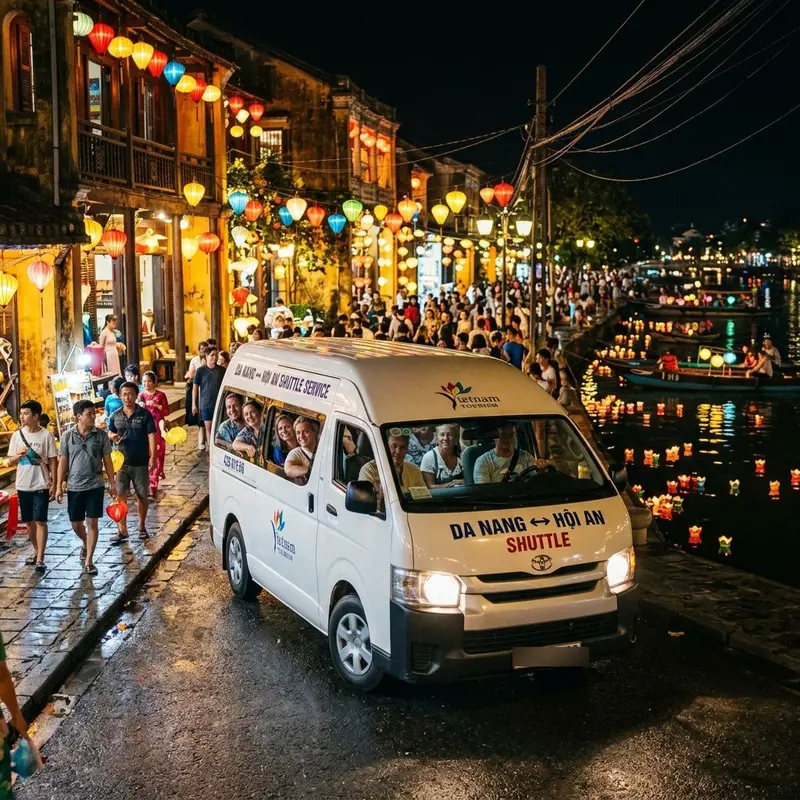
My experience after many years of bringing friends and family to Hoi An: booking a package car from the start is the smartest option. Instead of worrying about catching a taxi or Grab (which are often insufficient(especially during peak festival hours), I always recommend the Da Nang - Hoi An shuttle service by Faifo Express — a local transport provider I’ve trusted for many years.
Why Choose Faifo Express Over Taxis or Grab?
Faifo Express is not your typical taxi company. It’s a professional shuttle service with local drivers — many of whom were born and raised in Hoi An, know every alley, every parking spot, and most importantly, know when to travel and which roads to avoid during festivals.
I’ve witnessed tourists being ripped off by unmarked motorbike taxis and regular taxis during the Full Moon festival — prices could go up to 300,000-600,000 VND (≈$24) for a journey that should only cost 180,000 VND (≈$7). With Faifo Express, the price is fixed, with no extra charges, and the vehicles are always on time. They also offer a very convenient Da Nang airport shuttle service if you’re flying in during a festival.
Furthermore, if you want to combine a visit to Ba Na Hills on the same trip, Faifo Express also has a Ba Na shuttle service with experienced drivers, helping you plan a flexible itinerary without worrying about transportation.
[!TIP] Book your Faifo Express shuttle at least 2-3 days in advance if you’re arriving during the Full Moon festival or other major holidays. On these days, vehicles are often fully booked very quickly. You can book directly through their website or contact their hotline for advice on a suitable itinerary.
Frequently Asked Questions
Frequently asked questions about Must-Visit Traditional Festivals in Hoi An
What is the best way to use this guide to Must-Visit Traditional Festivals in Hoi An: A Local's Guide?
Is Must-Visit Traditional Festivals in Hoi An: A Local's Guide suitable for a first-time visitor?
Can I combine Must-Visit Traditional Festivals in Hoi An: A Local's Guide with other nearby plans?
What should I confirm before making plans for Must-Visit Traditional Festivals in Hoi An: A Local's Guide?
How can I avoid last-minute problems with Must-Visit Traditional Festivals in Hoi An: A Local's Guide?
Tags
The Faifo Express
This article was written by the driver and travel consultant team at Faifo Express — over 5 years of experience in travel transport across Da Nang, Hoi An, and Hue. All information is based on real experience serving 5,000+ customers every month.
Related services
Airport Transfer
Hotel pickup, all-inclusive price
View DetailsDay Tour Car Rental
Ba Na Hills, Hoi An, My Son...
View DetailsShared Car
From just 100K VND/person
View DetailsTourist Car Rental
Explore the beauty of Central Vietnam with our private tourist car service.
View Details🛣️ Popular Routes
Follow Faifo Express
Get exclusive deals, real reviews and the latest Central Vietnam travel tips.
Faifo Express
Updates, customer reviews & real trip photos.
@trm.anh.travel
Real experience videos, Da Nang – Hoi An travel tips.
@xedichvudananghoianhue
Real videos of routes, fleet and transfer services.
@xedananghoianFE
Quick news, flash deals and direct interaction.
DM us on Facebook — response within 5 minutes