


The Japanese Bridge After Its 2026 Restoration: What's Changed, 25 Details to Notice
📋 Table of Contents
There’s something locals in Hoi An never tell visitors: The Bridge Pagoda isn’t just a photo spot. It’s the living heart of the old town — where 400 years of trading port history, cultural exchange, and folk spirituality coexist within a humble wooden structure spanning a narrow waterway.
I’ve driven hundreds of visitors here, and their reactions are always the same: at first, they’re surprised how small it is compared to imagination. Then, after lingering — when morning light streams through the old wooden pillars, when you hear the story of Japanese merchants building a bridge and Vietnamese adding a shrine — they understand why this place matters.
After the most significant restoration in its history (2023–2024), the Bridge Pagoda now shines again with original brilliant red lacquer. This is your complete guide to understanding and fully experiencing Hoi An’s most iconic symbol.
[!NOTE] Pricing Note for International Tourists The prices listed are inclusive of a 20% tax and service fee applied to foreign tourists. Estimated USD rates are based on current exchange rates and may slightly vary.
400 Years of Bridge Pagoda History
Who Built It and Why?
The Bridge Pagoda was constructed by Japanese merchants around the early 17th century (some records cite 1593, others 1617). Back then, Japanese and Chinese communities lived on opposite sides of a narrow canal — the bridge connected these neighborhoods, serving as both a crossing and shelter from sun and rain for traders.
The Chinese name “Lai Vien Kieu” (來遠橋) meaning “bridge welcoming guests from afar” was bestowed by Lord Nguyen Phuc Chu in 1719 — a beautiful name reflecting Hoi An’s open spirit toward international commerce.
Why Is There a Shrine Inside?
The strangest thing about the Bridge Pagoda: on the north side sits a small shrine dedicated to Huyen Thien Dai De (Guardian of the North). According to legend, Japanese merchants believed a mythical creature called Mamazu lay beneath the Pacific Ocean — its head in India, tail in Japan, and body passing through Hoi An. When it moved, it caused earthquakes. The bridge was built like a sword pinning Mamazu’s back to keep it still. The shrine was meant to honor the deity controlling these underwater forces.
Later, the Hoi An community added worship of a deity protecting seafaring merchants. Today, locals still come daily to pray — especially before long journeys.
Through Various Restorations
The Bridge Pagoda has undergone at least 6 major restorations throughout history (1653, 1763, 1817, 1875, 1915, 1986) — each leaving aesthetic marks from its era and the communities performing the work (Japanese, Chinese, Vietnamese). This is why the current architecture uniquely blends multiple styles, not purely Japanese as many assume.
The 2023–2024 Restoration: What Changed?
Why Restoration Was Needed
Over centuries, the bridge’s foundation and pilings suffered severe deterioration from moisture, termites, and shifting ground. Key wooden support structures risked collapse without timely intervention.
What Was Restored
After careful research using historical photographs and consultation with international preservation experts:
- Paint Color: Restored to brilliant red lacquer matching the original 17th–18th century appearance, replacing the dark brown from the 1986 restoration
- Wooden Structure: Replaced rotted beams with jackwood — a traditional hardwood used in historic Hoi An architecture
- Foundation: Reinforced the pile foundation system using modern techniques while preserving exterior appearance
- Roof Tiles: Replaced old tiles with hand-fired tiles following traditional specifications
- Shrine Statues: Cleaned and preserved the shrine’s internal statuary
[!NOTE] The bright red color has sparked debate among Hoi An residents accustomed to the old darker shade. However, 19th and early-20th century photographs confirm the new red more closely matches the original.
 Bridge Pagoda after restoration — its new look with red lacquer closer to the original 17th-century appearance.
25 Fascinating Facts About Bridge Pagoda Most Visitors Don’t Know
1. The bridge is only 18 meters long — much smaller than expected, yet this is precisely what makes it special: a tiny structure with enormous historical influence.
2. Two mythical animals guard each end — the west end features a dog (representing the Year of the Dog), the east end a monkey (Year of the Monkey). The Japanese began construction in the Year of the Dog and completed it in the Year of the Monkey.
3. A small boat dock lies beneath — merchants could moor boats directly under the bridge to escape sun and rain while conducting business.
4. The bridge was closed for an extended period — from 2023 to mid-2024 for restoration, many visitors could only admire it from outside.
5. “Pagoda” isn’t technically accurate — the shrine inside is actually a “temple” worshipping Taoist and folk deities, not Buddhist. The popular name “Bridge Pagoda” has become the official designation.
6. It appears on Vietnam’s 20,000 VND note — the bridge is featured on the reverse of the Vietnamese 20,000-dong polymer banknote, affirming its status as a national cultural icon.
7. The best view isn’t from on top — but from the canal below, or from the opposite bank looking back, especially at dawn when golden light casts and water reflects perfectly.
8. The deck is laid with jackwood planks — a hardwood resistant to moisture, naturally fragrant, and extremely durable in tropical humidity. Walking across produces a distinctive creaking that’s unforgettable.
9. The roof has 3 layers of tiles — not just for waterproofing, but to regulate temperature: bottom tiles keep cool, middle tiles insulate, top tiles shed rain.
10. A mysterious well lies inside the shrine — a small ancient well sits beside the main altar; its original purpose and origin remain questions for researchers.
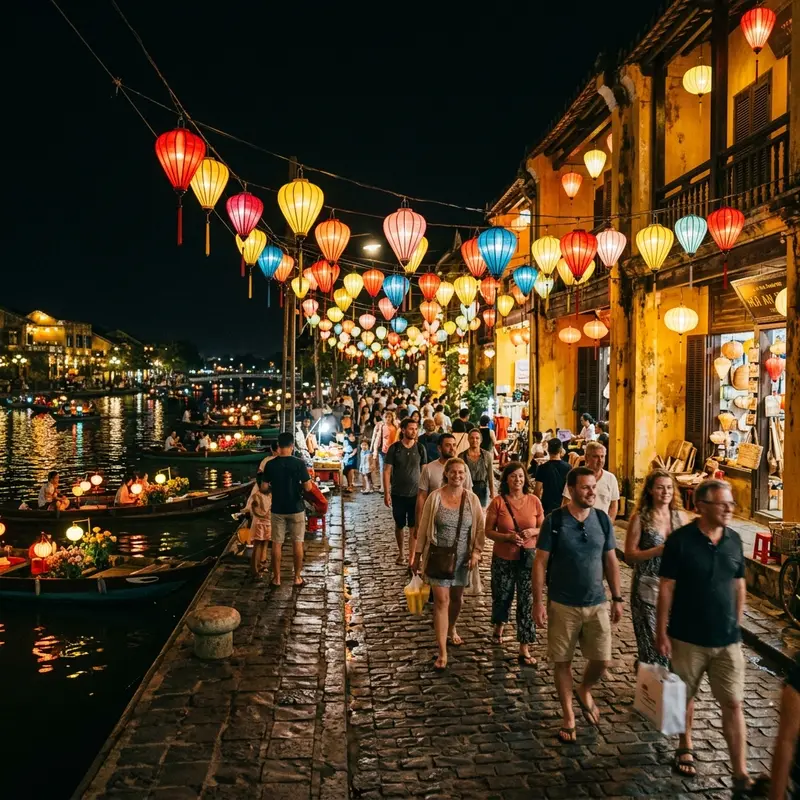
11. The bridge has flooded multiple times in history — high water marks from major floods are still visible on nearby old houses.
12. The French once wanted to demolish it — during French colonial period, infrastructure development proposals included destroying the bridge to widen roads. Fortunately, it was never implemented.
13. Bridge Pagoda is ground zero of the old town — many ancient streets are numbered from the bridge, and most tourist itineraries begin and end here.
14. Incense burns 24/7 inside the shrine — residents take turns ensuring the burning never stops, a tradition continuing since the shrine’s construction.
15. There’s a “sister bridge” in Japan — a similarly-styled bridge in Nagasaki prefecture was built following the same design, evidence of lasting connections between Japanese merchants and Hoi An.
16. The wooden structure uses no iron nails — entirely wooden mortise-and-tenon joinery. This allows the structure to “breathe” with temperature and humidity changes without cracking.
17. Early morning reveals chanting rituals — around 6–7 a.m., shrine keepers perform incense-lighting and chanting ceremonies. Experiencing this offers a completely different perspective than daytime crowds.
18. The canal was once much wider — the waterway once accommodated mid-sized merchant vessels. Today it’s shallower and narrower due to centuries of silt accumulation.
19. The east side was Chinese, the west side Japanese — this geographic division reflected the social structure of commercial Hoi An. Today this boundary exists only in history books.
20. The Bridge Pagoda appears in Vietnamese literature — from folk verses to modern novels, including the famous saying: “Whoever visits the Bridge in Hoi An / Leaves behind love, memory, and longing for someone.”
21. Its colors shift throughout the day — brilliant red under morning sun, slightly faded in harsh midday glare, warm amber in evening light, magically glowing under lantern light at night. Every moment reveals a different bridge.
22. Bats shelter in the roof — at dusk, dozens of bats emerge from roof tiles to hunt — a wild, poetic sight amid the ancient town.
23. The bridge may close on major religious holidays — certain festivals and religious observances close the site to tourists for local worship ceremonies.
24. This was Hoi An’s first preservation project — after UNESCO recognition in 1999, the Bridge Pagoda became the first structure to receive international restoration funding.
25. Japanese descendants still visit annually — descendants of original Japanese merchants return to Hoi An to burn incense here, honoring their ancestors’ legacy.
Best Photography Angles at Bridge Pagoda
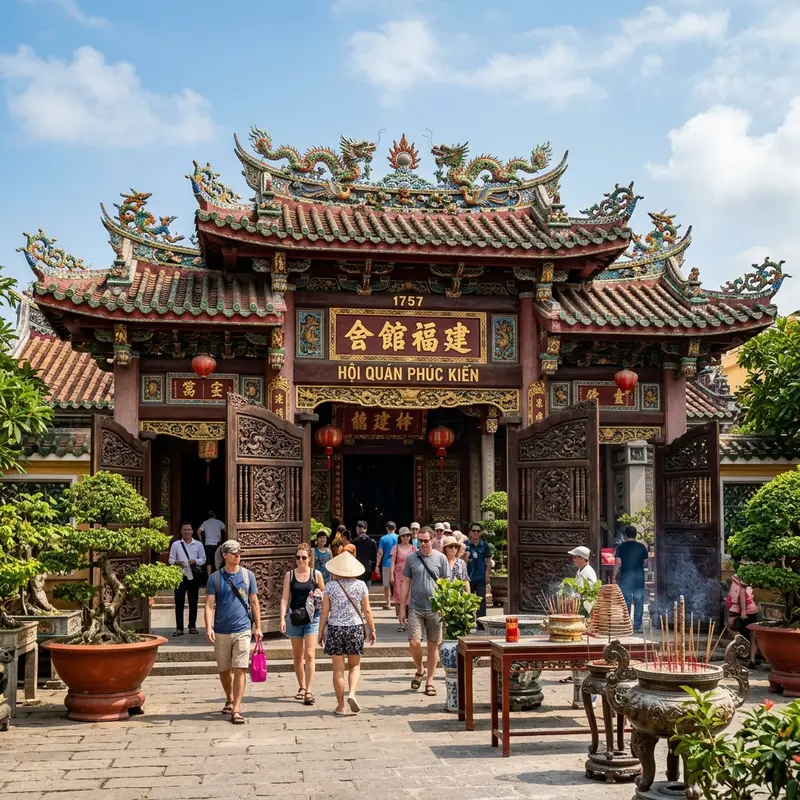
3 Must-See Angles
Angle 1 — From the opposite bank at dawn: Stand on Nguyen Thi Minh Khai Street (south bank) facing the bridge. Between 6:30–7:30 a.m., light approaches from the east, hitting the bridge face directly and creating warm amber tones. The still water perfectly mirrors the structure.
Angle 2 — From the canal below looking up: Descend the steps beside the bridge, stand near the water’s edge, and gaze upward. This perspective from below reveals the bridge’s height and grandeur in a completely different way.
Angle 3 — Standing at the bridge’s center looking toward one end: Position yourself at the bridge’s midpoint, frame one end ahead. You’ll capture the wooden gallery’s depth with light streaming through both ends — remarkably striking composition.
[!TIP] Camera settings: ISO 100-400, f/8, 1/250s shutter speed in morning; f/2.8, ISO 800–1600 for nighttime lantern shots. On smartphones: enable HDR and use Pro mode for exposure control.
[!WARNING] Don’t use flash inside the shrine — it obscures details and disturbs other visitors and the sacred atmosphere.
What to Do Within 200m of Bridge Pagoda
Where to Eat Nearby?
- Banh Cao Lau Ba Be (26 Thai Phien, 50m away): 50,000 VND (≈$2)–60,000 VND (≈$2)/bowl
- Phuong Bread Shop (2B Phan Chau Trinh, 150m): 40,000 VND (≈$2)–50,000 VND (≈$2)
- Banh Bao Banh Vac (533 Hai Ba Trung, 200m): 70,000 VND (≈$3)–100,000 VND (≈$4)/plate
- Numerous small cafes overlooking the canal: 40,000 VND (≈$2)–60,000 VND (≈$2)/drink
What to See Nearby?
- Phung Hung House (bridge’s west end) — stunning 3-style architecture
- Tan Ky House (101 Nguyen Thai Hoc, 2-minute walk)
- Phuc Kien Assembly Hall (46 Tran Phu, 5-minute walk)
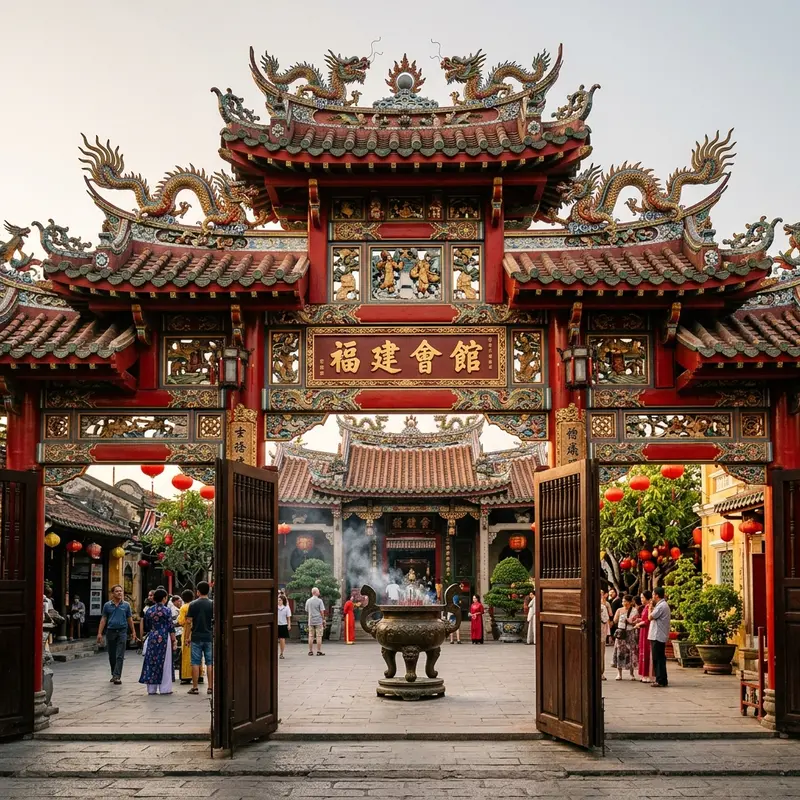 Phuc Kien Assembly Hall — a Hokkien shrine continuously restored since the 17th century, just 5 minutes from Bridge Pagoda.
- Hoi An Market (Bach Dang River bank, 3-minute walk)
Full Moon Night at Bridge Pagoda — The Most Special Experience
On full moon nights (14th day of lunar month), Bridge Pagoda becomes one of Hoi An’s most magical spots during the monthly lantern festival. Electricity shuts down across the old town — only lantern and candlelight remain. Under soft golden light, the bridge’s reflection on water becomes unforgettable.
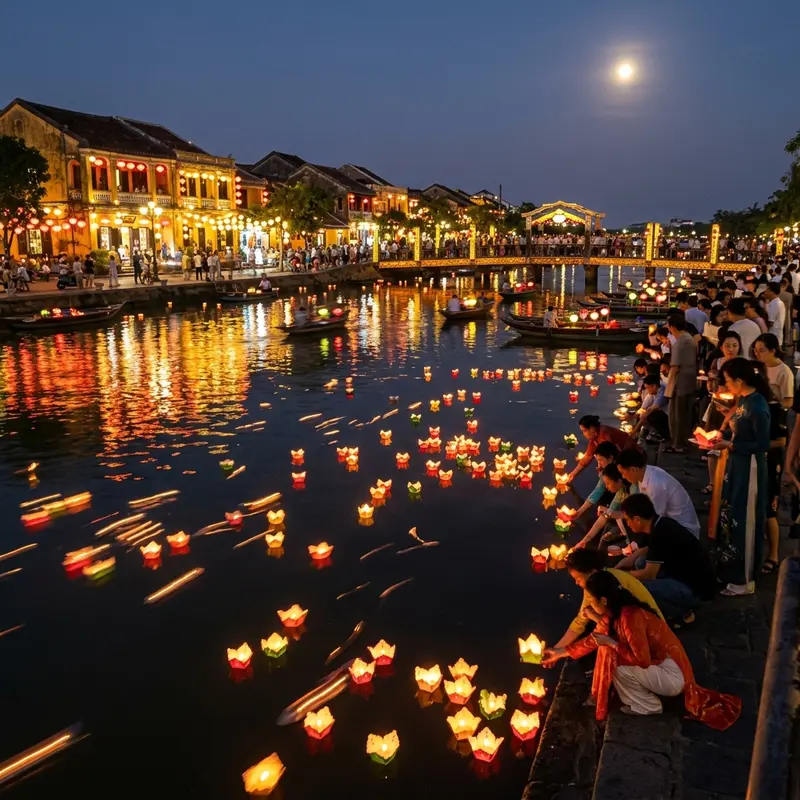
[!TIP] 2026 full moon lantern dates: January 13, February 12, March 13, April 12… (calculated by lunar calendar — 14th day of each lunar month).
Bridge Pagoda Visitor Guidelines
[!WARNING] Dress Code: Wear respectful attire when entering the shrine — shoulders covered, no excessively short shorts. Some areas offer scarves for loan.
[!NOTE] Hours: Bridge exterior is open all day (free). Shrine interior: 8:00 a.m.–12:00 p.m. and 1:30 p.m.–5:30 p.m. Religious holidays may close the shrine.
[!WARNING] Don’t climb or touch ancient wooden structures: Oils from hands damage historic wood. Respect heritage — this isn’t just a tourism spot but a sacred place for the community.
[!TIP] Throwing Coins: Some tourists toss coins into the water “for luck.” This isn’t local tradition — respectful prayer inside the shrine following local customs is more appropriate.
Getting to Hoi An from Da Nang
For the most convenient journey to see Bridge Pagoda, book a ride through Faifo Express from Da Nang Airport — fixed price 300,000 VND (≈$12), local-expert drivers who can advise on exploring the old town.
Browse services at /dich-vu or pricing at /bang-gia.
The Bridge Pagoda is one of the rare structures where spiritual and historical value far exceeds its physical dimensions. An 18-meter wooden bridge, yet containing 400 years of stories about people from different cultures finding meeting points — in commerce, in faith, in architectural craft.
Arrive before 8 a.m. Sit down. Watch the still water reflect the bridge’s red brilliance, and listen to the stories each aged wooden beam is quietly telling.
May your Bridge Pagoda visit be truly meaningful! 🌸
Frequently Asked Questions
Frequently asked questions about Hoi An Bridge Pagoda 2026
Is Hoi An Bridge Pagoda restoration complete?
What's the entrance fee to Bridge Pagoda?
Where is the Bridge Pagoda in Hoi An's old town?
What's the best time to photograph the Bridge Pagoda?
What's the significance of the Bridge Pagoda in local beliefs?
Tags
The Faifo Express
This article was written by the driver and travel consultant team at Faifo Express — over 5 years of experience in travel transport across Da Nang, Hoi An, and Hue. All information is based on real experience serving 5,000+ customers every month.
Related services
Airport Transfer
Hotel pickup, all-inclusive price
View DetailsDay Tour Car Rental
Ba Na Hills, Hoi An, My Son...
View DetailsShared Car
From just 100K VND/person
View DetailsTourist Car Rental
Explore the beauty of Central Vietnam with our private tourist car service.
View Details🛣️ Popular Routes

Follow Faifo Express
Get exclusive deals, real reviews and the latest Central Vietnam travel tips.
Faifo Express
Updates, customer reviews & real trip photos.
@trm.anh.travel
Real experience videos, Da Nang – Hoi An travel tips.
@xedichvudananghoianhue
Real videos of routes, fleet and transfer services.
@xedananghoianFE
Quick news, flash deals and direct interaction.
DM us on Facebook — response within 5 minutes