


Golden Bridge Ba Na Hills: 25 Photo Spots Worth the Climb
📋 Table of Contents
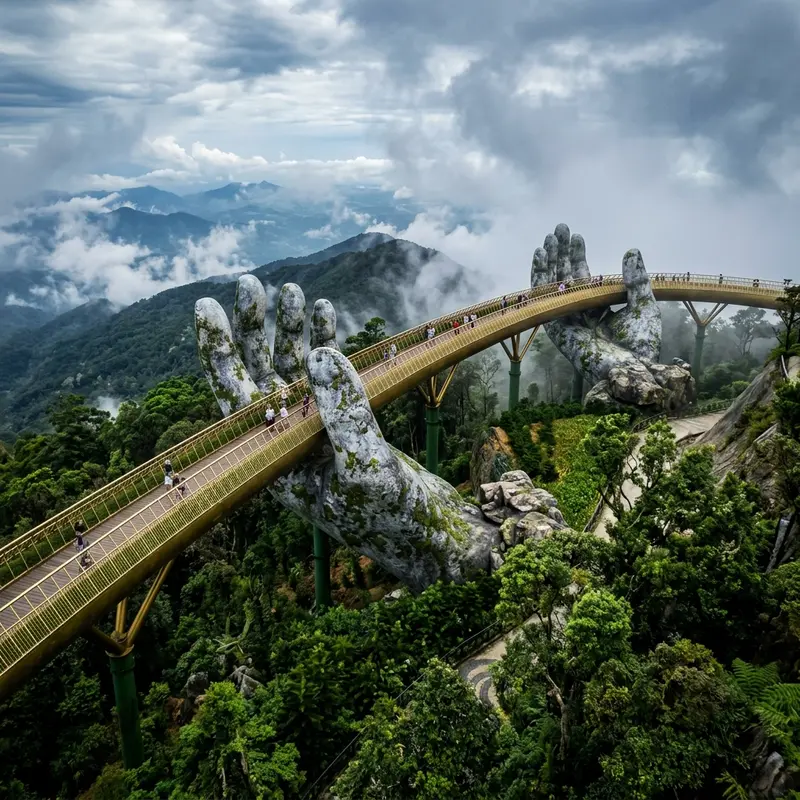
There are certain structures that take only one glance for you to realize you’re standing before something completely different from anything you’ve ever seen. Golden Bridge Ba Na Hills is one of those rare places—a shimmering golden ribbon 150 meters long, gently supported by two enormous moss-covered stone hands, suspended between layers of billowing white clouds at 1,400 meters above sea level.
When Golden Bridge first appeared in international media in mid-2018, the world’s reaction was nearly one of astonishment. BBC called it “the most beautiful bridge on the planet.” CNN ranked Golden Bridge among the most impressive architectural works of the decade. Millions of photos flooded social media within weeks, and suddenly, Da Nang—the peaceful coastal city of central Vietnam—appeared on the global tourism map in a way no one could have predicted.
But what made Golden Bridge surpass thousands of other modern structures worldwide to captivate millions of visitors’ hearts? It’s not purely aesthetic beauty—it’s the unique fusion of wild nature and human imagination. Two weathered stone hands, cracked and moss-covered as if sculpted by nature over millennia, supporting a gleaming golden bridge—that image evokes a mythological story of mountain gods gifting humanity a path to heaven.
This article is far more than a typical travel guide. It’s a comprehensive collection of genuinely useful secrets—from 25 carefully curated photo angles honed through years of experience, to insights about light, timing, and overlooked spots most visitors miss. Whether you’re a professional photographer seeking stunning shots or simply a traveler wanting to preserve a beautiful memory—you’ll find what you need here.
Golden Bridge History — From Concept to Global Icon
To truly understand and appreciate Golden Bridge, you must know the story behind those golden spans. This wasn’t randomly constructed—it’s the result of profound creative vision, where architecture meets philosophy and nature.
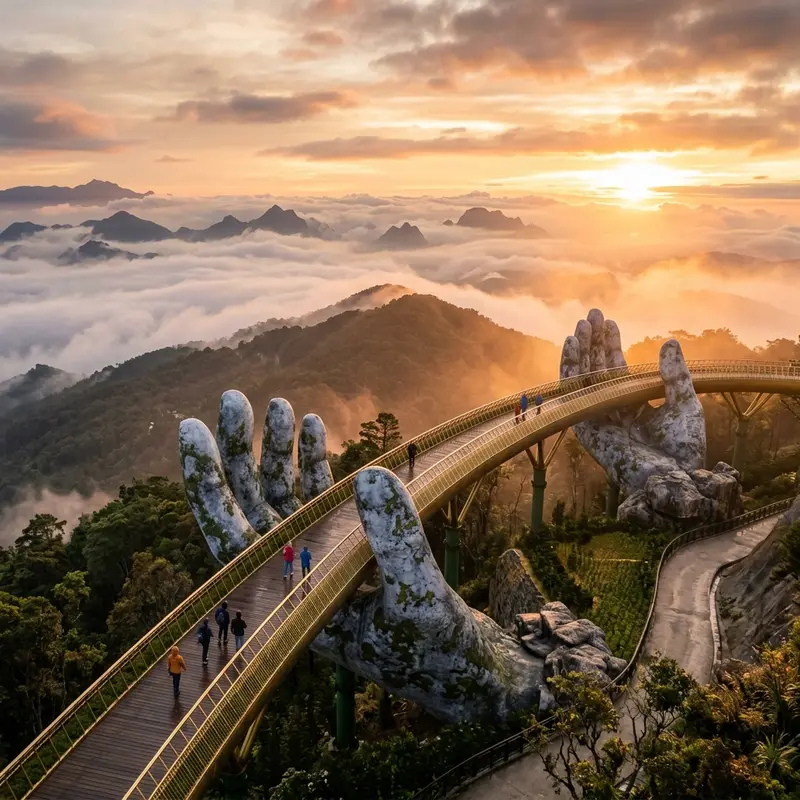
Golden Bridge was designed by TA Landscape Architecture, headquartered in Ho Chi Minh City. The core concept of the entire design is beautifully simple yet deeply symbolic: it’s a “golden thread” gifted by mountain gods, stretching from pristine forest down to a charming French village—as if the gods are offering humanity a passage into their world.
The two colossal hands were cast from reinforced concrete and covered with meticulously crafted artificial stone, with cracks, crevices, and moss patches created by hand to such perfection they’re nearly indistinguishable from natural stone. Each hand stands about 12 meters tall with support columns reaching dozens of meters in diameter, ensuring perfect structural integrity in Ba Na’s harsh mountain weather conditions.
Golden Bridge officially opened in June 2018, after more than a year of meticulous construction. The entire 150-meter bridge sits at 1,400 meters altitude—higher than many mountain peaks in the United States. From the bridge, visitors can see across all of Da Nang city, the deep blue coastline stretching endlessly, and overlapping mountain ranges of the Truong Son Range.
Within weeks of opening, an aerial photograph—wide-angle, capturing both stone hands and golden bridge amid billowing white clouds—posted on Instagram and spread at incredible speed. BBC News shared it, followed by CNN Travel, The Guardian, Time Magazine… Within less than a month, Golden Bridge Ba Na Hills became the most-searched keyword in Southeast Asian tourism.
Since then, Golden Bridge has continuously appeared in lists of world’s most impressive architectural works from major international organizations. In 2019, it won the Asia-Pacific region’s outstanding landscape design award. Millions of visitors from all five continents have walked here, and none leave without carrying a profound emotion in their hearts—a blend of amazement, humility before nature, and pride in Vietnamese human creativity.
25 Best Photo Angles at Golden Bridge
This is the core of the article—25 viewpoints and photo angles carefully selected through years of experience and countless visitor observations. Each angle includes precise location descriptions, camera settings tips, and what makes that frame special.
Angle #1: Looking Upward From North Staircase Base
This might be the single most visually shocking angle in the entire 25. From the base of the staircase leading up to the bridge’s north side, lower your camera near ground level and tilt up 45-60 degrees to capture the entire north hand with the golden bridge arcing upward into sky. Shooting against morning sunlight creates magnificent lens flare effects. Use a wide-angle lens (16-24mm), f/8 aperture to ensure sharpness from foreground to distant hands.
Angle #2: Standing Mid-Bridge Looking East
From the bridge’s center, face east (toward Da Nang sea), you’ll see a spectacular panorama: the golden span stretches ahead, beautiful railings on both sides, and the distant glimmering blue sea on the horizon. Shoot in landscape 16:9 ratio, using leading line technique to guide viewers’ eyes along the bridge toward the sea. 9-10 AM is ideal when eastern light shines brilliantly.
Angle #3: Sunrise 7:00–8:00 AM With Thick Mist
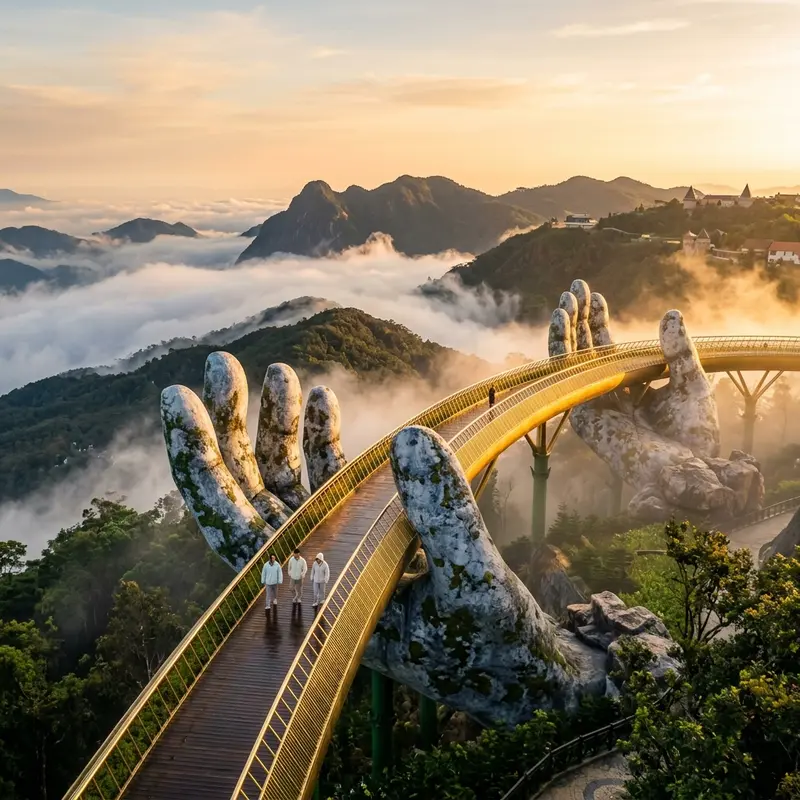
If you can only choose one time slot all day to visit Golden Bridge, choose 7:00-8:00 AM. Mist still clings to the mountain, dawn light begins penetrating from the east, creating ethereal golden rays piercing through the mist veil. The bridge is nearly deserted. Set manual mode, ISO 400-800, 1/125s shutter speed, f/5.6 aperture to capture mist texture while keeping the bridge sharp. The resulting photo will have depth and atmosphere no other hour can replicate.
Angle #4: From Le Jardin Garden’s Edge Looking Toward Bridge
From the eastern edge of Le Jardin D’Amour flower garden—with colorful flower beds—turn west to see Golden Bridge like a golden ribbon standing out against lush tropical forest. Perfect for combining flowers and bridge in one frame. Use 70-200mm telephoto, focus on bridge with flowers softly blurred in foreground for beautiful bokeh effect.
Angle #5: Sitting On Bridge Railing Looking Down at Cloud Sea
One of Golden Bridge’s most unique experiences is sitting on the railing looking straight down at an endless white cloud sea completely obscuring the ground below. Shoot this angle with wide-angle lens pointing straight down, capturing both the golden railing and clouds beneath. The sensation of floating between sky and clouds—no words fully capture it—and this photo will convey that emotion.
Angle #6: 45-Degree Angle From South Looking Up at North Hand
Move about 20-30 meters south of the bridge, turn facing north, angle your lens up about 45 degrees toward the north hand. This composition shows the hand’s full height and actual size—powerful perspective making viewers sense the structure’s grandeur. Include a person in the foreground to create contrast, helping viewers understand the hand’s true scale compared to humans.
Angle #7: Reflection Shot When Lightly Raining
On light rain days or after rain, the bridge surface becomes mirror-like with small pools of water. Perfect conditions for symmetrical reflection photography—images of hands and bridge reflected upside down on the wet bridge surface. Lower your camera angle, position lens close to the surface (using wide-angle), capturing both the reflection below and actual structure above. The result is a perfectly symmetrical artistic photograph.
Angle #8: Total Panorama From Moon Gazing Peak
Moon Gazing Peak—the highest accessible point in Ba Na Hills—offers 360-degree breathtaking vistas. From here using 70-200mm or super-telephoto lens, you can photograph Golden Bridge from afar—the structure becoming a delicate golden line against lush mountain forest backdrop. Technically challenging but rewarding—a unique panoramic angle unavailable elsewhere.
Angle #9: Photography From Cable Car Passing Bridge
When the cable car slowly approaches the Golden Bridge area, prepare your camera and shoot continuously. The cable car perspective provides unique overhead composition—seeing the bridge from above and outside, capturing both hands and span in single frame. Turn off flash and open windows if possible to avoid glass reflections.
Angle #10: Silhouette at Sunset
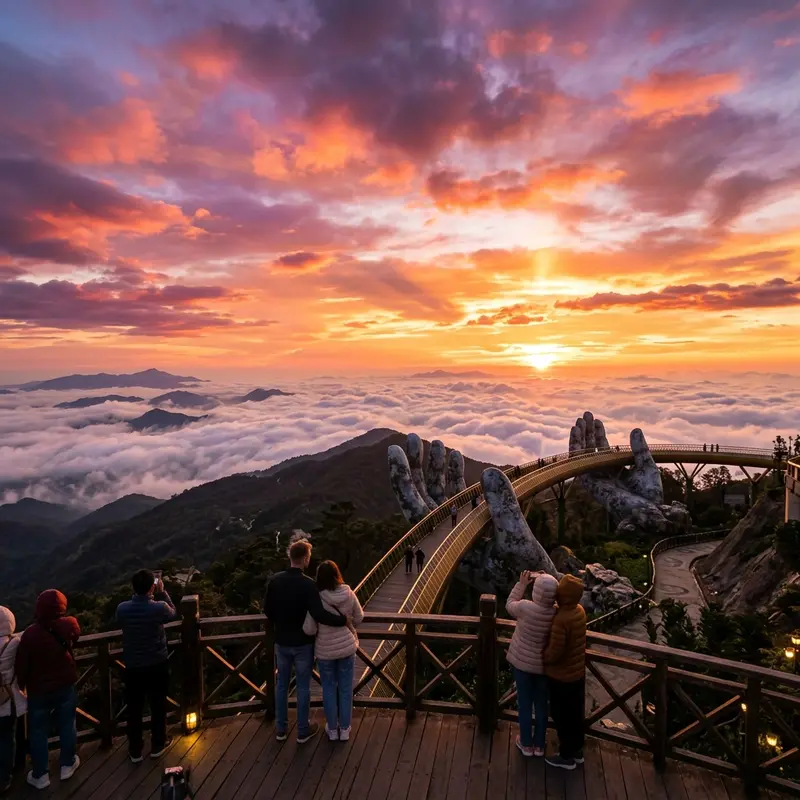
Around 5:30-6:30 PM as the sun descends westward, sky transforms through golden-red-purple hues. Stand at the bridge’s east end, point your camera westward—against the setting sun. The hands and bridge become dark silhouettes against the brilliant sky backdrop. Classic silhouette technique, but applied to Golden Bridge’s distinctive features, creates a dramatically emotional photograph.
Angle #11: Combining with Le Jardin Flowers in Bloom
During flower season (typically March-May), Le Jardin D’Amour overflows with color from dozens of flower species. Position yourself so abundant flowers fill the foreground (chrysanthemums, roses, or lavender), with Golden Bridge appearing behind in the background. Use 50mm or 85mm lens at f/1.8-f/2.8 aperture for beautiful flower bokeh while keeping bridge recognizable.
Angle #12: Macro Details of Stone Hands
Few notice this detail—standing close to the hands, you’ll discover incredible craftsmanship: cracks, moss patches, stone textures, crevices…all hand-created with stunning precision. Using macro lens or phone’s close-focus feature, shoot these details from 10-30cm distance. Macro photos often surprise viewers with unexpected beauty.
Angle #13: Standing at West End Looking Along Bridge
From the bridge’s west end—where it meets the French village—look eastward along the bridge’s length. This is the most classic and frequently photographed angle, yet always beautiful. The straight bridge line draws viewers’ eyes into infinite perspective. Shoot when few tourists are present for clean composition—a person standing at the distant bridge end creates the perfect accent point.
Angle #14: From Beneath South Hand (Less Common)
The south hand—often less photographed than its northern twin—has unique beauty when viewed from below. Standing at the bridge’s south area looking up at the south hand provides a completely different perspective. Combined with blue sky or billowing white clouds behind, the photo achieves beautiful color contrast: the gray-green hand color contrasts beautifully against blue sky.
Angle #15: Super Wide-Angle Including Both Hands and French Village Behind
One of the technically most challenging but visually impressive angles. From mid-bridge slightly toward the railing edge, use ultra-wide lens (12-16mm) to capture both hands on sides, the entire golden span below, and charming French architecture misty in the background. Requires good light and appropriate mist conditions for optimal results. Angle #16: Late Afternoon When Slanted Sun Creates Warm Light
From 2:00-4:30 PM, afternoon sun angle creates long shadows and the warm “golden hour” light characteristic of late afternoon. This slanted light illuminates every hand detail—each crack, moss patch—while making the bridge’s yellow more vibrant than ever. Shoot from the east facing west for bright sky backdrop and afternoon light beautifying the entire scene.
Angle #17: From Cafe Northwest of Bridge
Northwest of Golden Bridge sits a small cafe with outdoor seating. From here, coffee cup in hand, you have a natural 3/4 view of the entire bridge—unforced, natural, with depth. Also ideal for “lifestyle” photography—combining relaxing people with the bridge backdrop. Early morning light from the east creates the best effect for this angle.
Angle #18: Along Center Corridor With Thick Mist
The most ethereal angle—possible only on heavy mist days. Standing centrally between hands, looking along one end, dense mist becomes a mystical veil. Only railings, the golden surface, and stone hands emerge through mist—creating minimalist composition with surreal beauty like a watercolor painting. Use higher than normal ISO (800-1600), proper exposure to preserve mist texture.
Angle #19: Combining with White Hydrangea Flowers in Summer
During summer (June-August), white hydrangea bushes bloom abundantly near Golden Bridge. These perfectly round white flower clusters create elegant foreground when combined with golden bridge backdrop. Shoot early morning when flowers still hold dewdrops, using 85mm at f/2 aperture for silky flower bokeh with bridge clearly visible behind but not dominating.
Angle #20: Mirror Reflection From Decorative Glass at Bridge End
A subtle detail few notice—decorative glass or reflective surfaces exist at bridge ends. Place your camera against these surfaces, photograph the Golden Bridge reflection within, creating unique composition where reality and reflection coexist in one frame. The angle often surprises viewers who must study carefully to understand the composition.
Angle #21: From Below North Hand Base Looking Straight Up
Approach the north hand base and angle your lens straight up vertically. This straight-up composition creates impressive architecture: the hand occupies entire frame’s center, extending upward to the golden bridge, finishing with sky or clouds above. Pure architectural perspective, highlighting structure’s scale and construction technique.
Angle #22: From Distance Using Telephoto Lens
If you carry a long telephoto lens (200-400mm), find distant observation points—perhaps Moon Gazing Peak or other elevated areas within Ba Na Hills. From these distances, compress the scene with telephoto to create unique compression effect—the bridge appears thicker, hands and bridge compressed together, the mountain backdrop becomes densely packed backdrop. This telephoto technique creates completely different perception of the same structure.
Angle #23: Combining with Fireworks During Festival Celebrations
If fortunate enough to be at Ba Na Hills during celebrations with fireworks—Lunar New Year, park anniversaries, or major events—the nights offer golden opportunities. Use tripod, set 3-8 second exposures, ISO 100-200, f/8-f/11 aperture. Position yourself where bridge and fireworks both appear in frame—the resulting photograph becomes an unforgettable memory.
Angle #24: Night Sky and Stars From Bridge
During special occasions when Ba Na Hills opens evening hours, Golden Bridge under warm yellow lights combined with star-filled night sky creates unbelievable scenery. Night sky photography here requires sturdy tripod, bright wide-angle lens (f/1.4-f/2.8), high ISO (3200-6400), and 15-25 second exposures. The 1,400-meter altitude, minimal light pollution, and Ba Na’s clean mountain air create ideal stargazing conditions.
Angle #25: Photography in Traditional Vietnamese Ao Dai
Concluding with a culturally rich angle—photographing in traditional Vietnamese ao dai at Golden Bridge. Vibrant ao dai colors—especially red, yellow, or white—create beautiful contrast and color harmony with the bridge’s yellow and forest green. Shoot early morning with few tourists, using 85mm at f/2.8 aperture for soft bridge background, the ao dai wearer becoming the photo’s main accent point. This combines cultural heritage with modern architecture—Vietnam’s story today.
Golden Hour & Light: Secrets Beyond the Guidebook
Light is photography’s soul, and at Golden Bridge, this truth rings louder than ever. Your chosen time slot determines everything—not just photo quality, but your entire experience.
7:00–8:30 — True Golden Hour
This is the most sacred timeframe at Golden Bridge all day. Mountain mist still lingers, dawn light from the east sends first warm golden rays through the mist veil creating incredibly ethereal effects. Temperature is pleasantly cool, air is fresh and clean, and almost no other tourists are present—except those who already know this secret. If you can arrange earliest cable car slot (usually 7:30 AM), go straight to Golden Bridge before anything else.
9:00–11:00 — Clear Light, Moderate Crowds
Mist begins dispersing, sky becomes clear blue, sunlight bright enough for sharp photography but not yet harsh. Tourist numbers start increasing but not yet overwhelming. Perfect timeframe for landscape photography requiring even, clear lighting.
11:00–14:00 — Avoid If Seeking Great Photos
Direct overhead sun creates harsh, flat, unflattering shadows. Highest temperatures of day. Maximum tourist congestion. If trapped during these hours, spend time exploring gardens, the wine cellar, dining, and wait for afternoon.
14:00–16:30 — Afternoon Golden Hour
Sun begins angling westward, creating warm golden light and long shadows—ideal conditions for highlighting hand stone texture and making bridge yellow more vibrant. Tourist numbers begin decreasing as many have finished their visits. Use this timeframe to re-photograph morning angles with different light.
17:00–18:30 — Sunset and Silhouette
As the sun approaches the western mountain peaks, sky transforms through warm tones—orange, red, purple. Ideal for dramatic silhouette photos, panoramic sunset images, and most emotional moments of the day. Often fewer visitors than morning since most tour groups have concluded.
[!TIP] Secret for photographing in mist: Mist is nature’s gift, not an obstacle. When mist is thick, increase exposure compensation +0.7 to +1.0 stops since cameras typically underexpose in white-out conditions. Use manual focus since autofocus struggles in heavy mist. Most importantly—don’t try removing mist from photos; let mist become part of your story.
[!WARNING] Peak hour warning: 10:00 AM-2:00 PM on weekends and holidays can see thousands of tourists simultaneously at Golden Bridge. Crowds, photo spot queues, and stuffy air are likely. If visiting Da Nang weekends, come Friday morning or arrange earliest 7:30 AM cable car—the only way to avoid crushing crowds.
Exploring Around Golden Bridge
Golden Bridge is merely the journey’s beginning—the surrounding area contains a world of natural beauty and distinctive architecture worthy of full-day exploration.
Le Jardin D’Amour Flower Garden
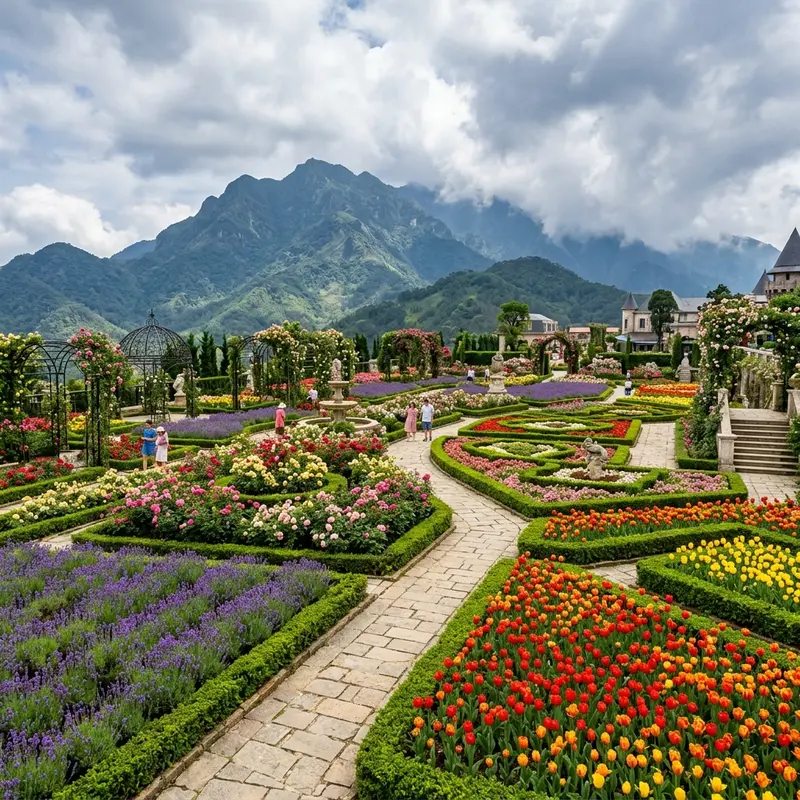
Immediately adjacent to Golden Bridge, Le Jardin D’Amour—“Garden of Love” in French—ranks among Southeast Asia’s most beautiful high-altitude flower gardens. Spanning over 7 hectares, designed in classical French garden style with immaculate flower beds, winding stone paths, ornate stone benches for couples, and romantic scenes at every corner.
Over 70 flower species bloom successively year-round, most spectacular during spring when tulips, roses, lavender, and chrysanthemums paint the garden hundreds of colors. Summer brings white hydrangeas and purple flowers, creating different elegant atmosphere.
Le Jardin D’Amour combined with Golden Bridge form a perfect photography zone—spend entire mornings here without exhausting beautiful angles. Bring tripod and macro lens to fully exploit every flower’s delicate beauty set against high mountain backdrop.
Debay Wine Cellar
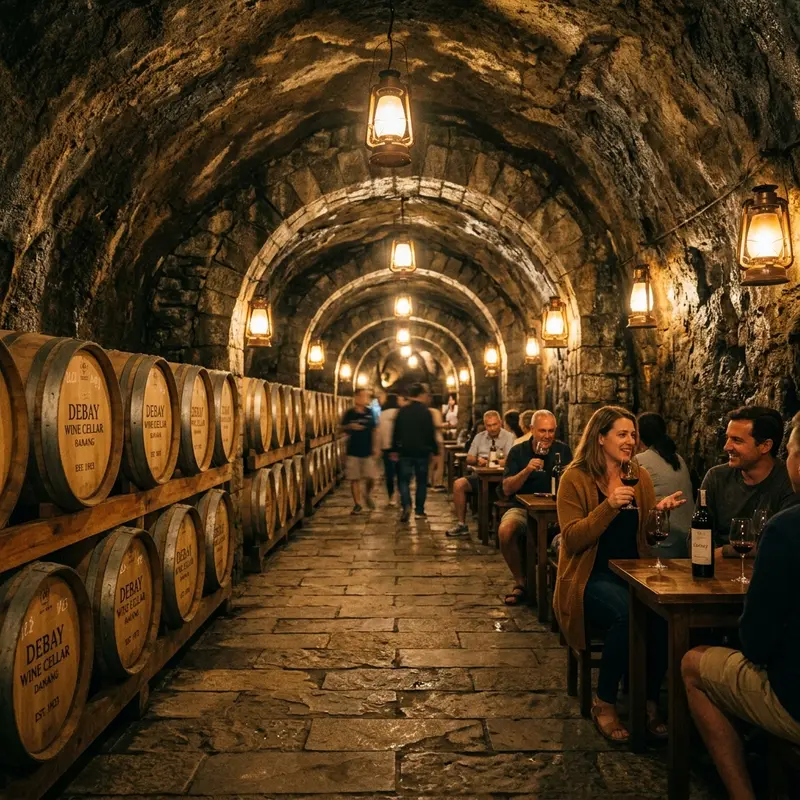
Among Ba Na Hills’ most mysterious and fascinating destinations is the Debay Wine Cellar—among Indochina’s oldest wine cellars, constructed by French in 1923 deep within the mountain to preserve wine under ideal natural temperature and humidity conditions.
Stepping into Debay Wine Cellar transports you to another world—cool natural temperature (around 16-18°C year-round), warm yellow light illuminating wooden barrels and vintage bottles, the combined fragrance of wood and wine in quiet air. Ancient stone walls and arched ceiling create otherworldly atmosphere—both romantic and mysterious.
Beyond touring, visitors can taste wines preserved in the cellar, learn Indochina’s French history through displayed documents, and photograph in the cellar’s incredibly photogenic warm yellow-lit space. Perfect for rest and photo opportunities.
Moon Gazing Peak
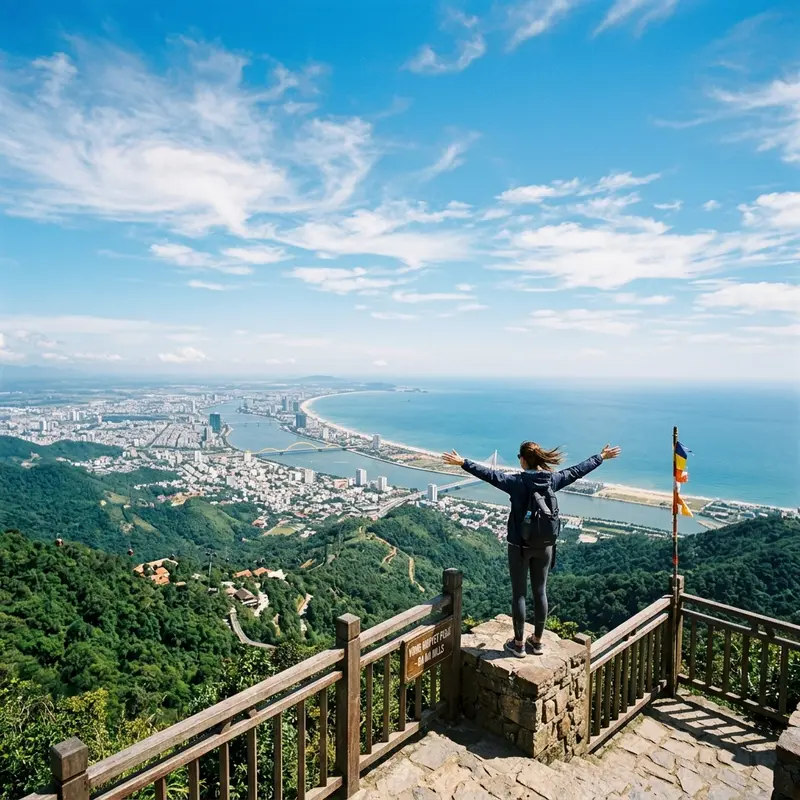
Ba Na Hills’ highest accessible point—Moon Gazing Peak (also called Nine-Cloud Peak)—offers unforgettable 360-degree panoramic views of all southern Truong Son Range and Da Nang’s coastline.
From Golden Bridge area, the scenic trail to Moon Gazing Peak requires 15-20 minutes of uphill hiking—not overly strenuous but requiring sturdy sport shoes. The reward: from the summit, on clear days, you can see across all Da Nang, Son Tra Peninsula, My Khe and Non Nuoc beaches stretching endlessly, even possibly Ho Chi Minh City reflected if visibility permits.
Sunset at Moon Gazing Peak is a rare experience few tourists enjoy due to timing requirements. As sun descends behind western mountain ranges, sky transforms yellow-orange-red—and below, white cloud sea billows through valleys like cumulus waves. No words fully capture the emotion of that moment.
Dining Near Golden Bridge
Ba Na Hills offers more dining variety than expected—from upscale buffet restaurants in the French village to convenient quick-bite stands near Golden Bridge.
French Village Buffet Restaurants
The French village near Golden Bridge hosts several buffet restaurants serving both Vietnamese and European cuisine. Lunch or dinner buffets range 340,000 VND (≈$13) to 480,000 VND (≈$19) per person—not cheap, but diverse portions and French colonial architecture dining space create interesting experience. Reserve tables in advance for weekends.
Outdoor BBQ Garden
An alternative interesting option is the outdoor BBQ area with spacious atmosphere and mountain views. Various grilled meats, seafood, and fresh vegetables are served as sets or a la carte from 180,000 VND (≈$7) per portion. Eating outdoors at 1,400-meter altitude with cool mountain breeze is unforgettable.
Light Bites and Coffee
Throughout the path from cable car station to Golden Bridge are numerous light food stalls: banh mi, sticky rice, rice porridge, sweet desserts… A traditional Vietnamese phin coffee (~50,000 VND (≈$2) to 80,000 VND (≈$3)) enjoyed in cool mountain air—simple but memorable. Some coffee stands have outdoor seating overlooking Golden Bridge—ideal spots for rest breaks and “lifestyle” photos.
[!NOTE] Bring snacks from below: Food prices at Ba Na Hills run significantly higher than downtown Da Nang—normal for high-altitude attractions with substantial transport costs. If arriving early with full-day plans, bring additional snacks from downtown: crackers, fruit, beverages. This allows flexibility and meaningful savings.
Getting to Ba Na Hills
From Da Nang Downtown
Ba Na Hills’ base sits roughly 25km west of Da Nang’s city center via Ho Chi Minh Highway (National Road 14G). Actual travel time approximately 40-50 minutes depending on traffic conditions. Choose from these options:
Taxi or Grab: Most convenient for small groups 1-4 people, ranging 240,000 VND (≈$9) to 340,000 VND (≈$13) one-way depending on vehicle type. Note: many taxi drivers don’t know Ba Na routes well and may take extra time.
Faifo Express — Private Transfer Service: For optimizing time and experience, Faifo Express’s private transfer service merits serious consideration. Pickup from airport or hotel, local driver familiar with roads and optimal timing, dropped directly at cable car station without unnecessary detours. Especially valuable for early 7:30 AM liftoff to have Golden Bridge almost entirely to yourself.
Cable Car to Summit
From Morin Station cable car (mountain base), the cable car line carries visitors to Ba Na Station at 1,400 meters altitude in approximately 20 minutes. This single-cabin cable car line holds world’s longest and highest record—a Guinness Record few tourists realize. The cable car journey itself proves incredibly impressive: watching tropical forest shrink below, mist appearing, and green mountain peaks surrounding you.
Cable car operating hours: 7:30 AM-9:00 PM daily (last entry usually 5:00-5:30 PM). Cable car plus Ba Na Hills entrance ticket currently costs 900,000 VND (≈$35) for adults and 720,000 VND (≈$28) for children 1-1.3 meters tall—covering complete experience including Golden Bridge.
[!NOTE] Faifo Express picks up at airport, takes you directly to cable car base: If arriving Da Nang on early morning flights wanting to maximize Golden Bridge time, reserve Faifo Express private transfer directly from airport. Driver delivers you to Morin Station, ensuring arrival before 9 AM—the day’s most beautiful hour.
Important Notes for Visitors
Ideal Seasons
Ba Na Hills stays beautiful year-round, each season offering unique charm. February-May (spring and early summer) offers clearest skies, most abundant flowers, least rainfall—optimal conditions for beautiful photos and comfortable experience. September-November also looks fine after rainy season ends, clearer skies and more photogenic mist. Avoid early October-November as main rainy season begins—Ba Na may be cloudy or rain-soaked all day.
Mountain Weather
Surprisingly, while downtown Da Nang reaches 35-38°C heat, Ba Na Hills measures only 20-25°C—sometimes 15-18°C evenings or cloudy days. Always pack a light jacket or windbreaker, even visiting summer. Closed-toe shoes with slip-resistant soles are smart since many paths get wet and slippery on light rain days.
Weekdays vs. Weekends
If possible with schedule flexibility, prioritize Ba Na Hills weekdays (Monday-Friday). Weekend visitor numbers can triple compared to weekdays, especially during national holidays. Weekdays provide more comfortable space for photography, shorter cable car queues, and overall better experience.
Drone Regulations
[!WARNING] Drones are completely prohibited throughout Ba Na Hills property. This is strictly enforced by Sun World Ba Na Hills. Security personnel regularly patrol and immediately demand drone retrieval if detected. Beyond policy violation, drone flight risks thousands of pedestrians below. Tripod or monopod allowed outside peak hours but mustn’t obstruct walkways.
Purchase Tickets in Advance
Especially peak season, ticket purchase queues can stretch 30-60 minutes. Pre-book online at our rates page to skip queues and guarantee earliest cable car slots.
Frequently Asked Questions
Frequently asked questions about Golden Bridge Ba Na Hills
Where is Golden Bridge Ba Na Hills located?
What time is best to visit Golden Bridge?
Is there an extra entrance fee for Golden Bridge?
What's the best photo spot at Golden Bridge?
Travel time from Da Nang Airport to Golden Bridge?
Tags
The Faifo Express
This article was written by the driver and travel consultant team at Faifo Express — over 5 years of experience in travel transport across Da Nang, Hoi An, and Hue. All information is based on real experience serving 5,000+ customers every month.
Related services
Airport Transfer
Hotel pickup, all-inclusive price
View DetailsDay Tour Car Rental
Ba Na Hills, Hoi An, My Son...
View DetailsShared Car
From just 100K VND/person
View DetailsTourist Car Rental
Explore the beauty of Central Vietnam with our private tourist car service.
View Details🛣️ Popular Routes
Follow Faifo Express
Get exclusive deals, real reviews and the latest Central Vietnam travel tips.
Faifo Express
Updates, customer reviews & real trip photos.
@trm.anh.travel
Real experience videos, Da Nang – Hoi An travel tips.
@xedichvudananghoianhue
Real videos of routes, fleet and transfer services.
@xedananghoianFE
Quick news, flash deals and direct interaction.
DM us on Facebook — response within 5 minutes