


Practical Travel Handbook: Hoi An: Rent a Bicycle to Explore the Countryside
📋 Table of Contents
Hoi An Through the Eyes of a Cyclist: When the Countryside Becomes a Living Painting
There’s a Hoi An that not everyone knows — not the Hoi An of vibrant lanterns in the ancient town, not the Hoi An of crowded cafes popular with Western tourists. This is the Hoi An of misty early mornings over lush green rice fields, of the chirping of frogs by small canals, of the scent of dry straw and wood smoke mingling in the breeze. To reach this Hoi An, you need a bicycle, a free morning, and the willingness to pedal slowly out of the comfort zone of the city.
Tips for renting a bicycle to explore Hoi An’s countryside is more than just a simple tourist activity — it’s the only way to truly “live” in the space that the people of Hoi An have inhabited for hundreds of years. This article is a compilation of my experiences cycling along the red dirt roads by the Thu Bon River with friends, family, and sometimes alone — experiences that no guidebook can tell you in enough detail.
Why is the Bicycle the “Soul” of Hoi An?
Hoi An and its Hundred-Year-Old Bicycle Culture
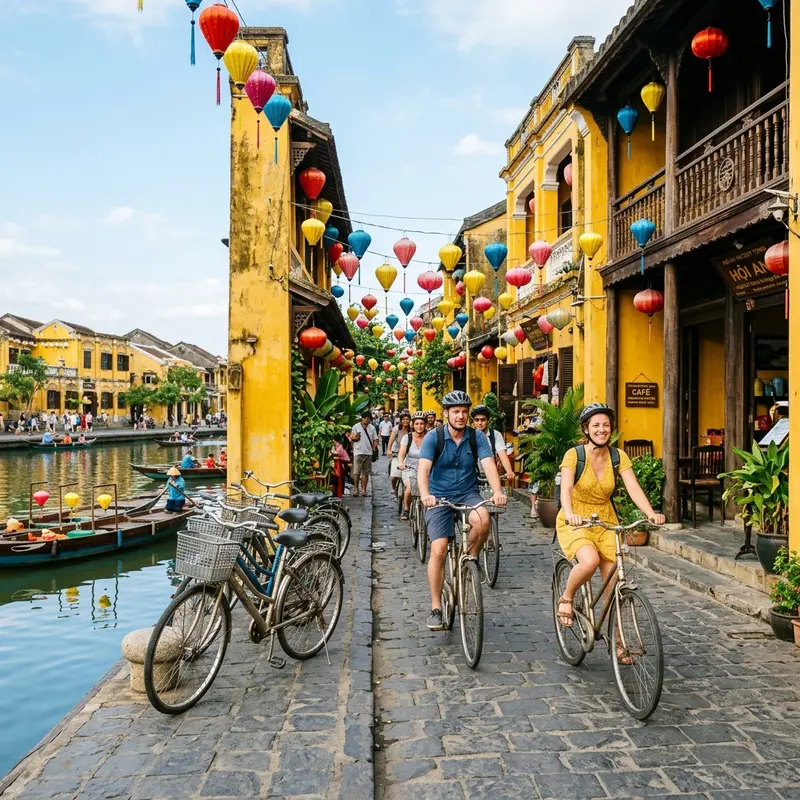
Hoi An’s association with bicycles is no accident. Since the French colonial era, when Hoi An was one of the busiest trading ports in Central Vietnam, bicycles were the primary mode of transportation for locals. The ancient town’s streets are narrow, with a dense network of alleys — cars cannot enter, and motorbikes are too noisy and fast — only bicycles are slow enough for you to look up at the moss-covered tiled roofs, quiet enough to hear the calls of street vendors, and flexible enough to turn into any small alley your intuition guides you to.
Hoi An people ride bicycles like Hanoians drink egg coffee — it’s a part of their identity, not a trend. You’ll see women wearing conical hats cycling to the market at 5 AM with baskets of vegetables. You’ll see middle school students holding a banh mi in one hand and cycling to school with the other. When you rent a bicycle and join this flow of people, you are no longer a tourist — you are a part of Hoi An.
Hoi An’s Countryside — A Severely “Underrated” Beauty
Most tourists visiting Hoi An only know the ancient town within a radius of less than 2km. In reality, the most beautiful and “authentic” part of Hoi An lies in its outskirts — the peaceful villages stretching from Tra Que Vegetable Village to the north, through the Cam Thanh rice fields, to Kim Bong Carpentry Village on the south bank of the Thu Bon River.
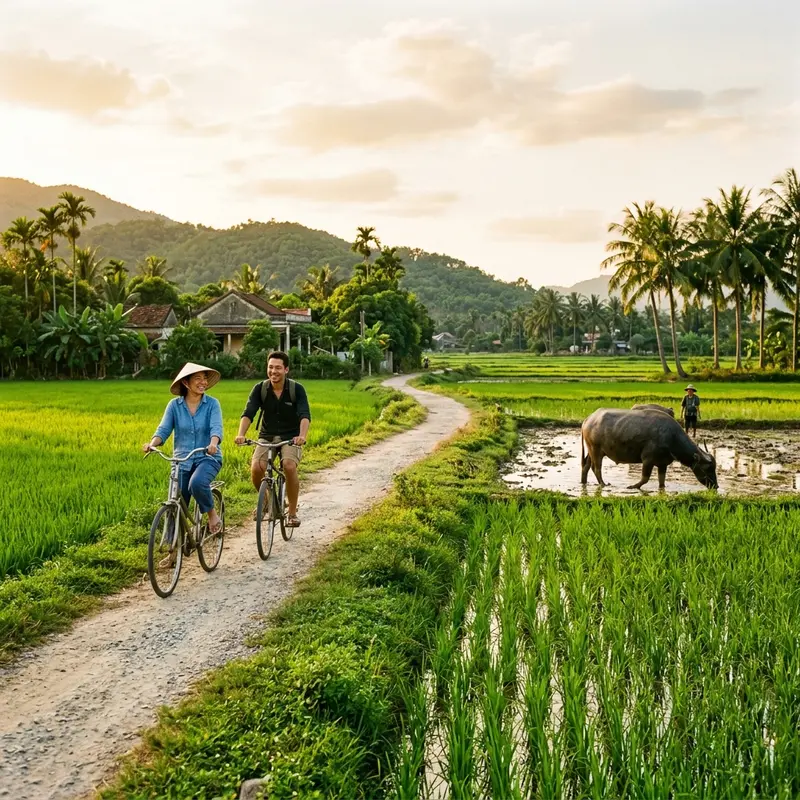
During the rice harvest season (the 5th and 10th lunar months), the entire vast plain turns a golden hue. The early morning sunlight slanting through the bowing rice stalks creates a scene that I can assure you won’t find in any Instagram photo — because it’s too beautiful for a camera to fully capture.
Guide to Getting to Hoi An to Start Your Cycling Journey
From Da Nang to Hoi An: Which Transportation to Choose?
If you are in Da Nang and want to go to Hoi An to experience cycling through the countryside, here’s the first thing to consider: do not drive a motorbike or take a Grab from Da Nang to Hoi An yourself.
Why? Because the distance from Da Nang city center to Hoi An Ancient Town is about 30km, passing through National Highway 1A and the coastal road — these are routes with high traffic density of trucks and buses, not safe for those unfamiliar with the terrain. Moreover, if you are already tired after a long journey, cycling…exploring immediately after would be exhausting.
The solution I always suggest to friends and family: use Faifo Express’s shuttle service — a local transport provider specializing in the Da Nang – Hoi An route. Their drivers are all locals, familiar with every road, know when traffic jams occur, and where to stop to buy local specialties along the way. The vehicles are clean, have cool air conditioning, and can be booked in advance via an app — you can relax and arrive with enough energy to cycle all day.
[!TIP] If you’ve just landed at Da Nang Airport, book Faifo Express’s airport shuttle service from Da Nang to Hoi An immediately. They have drivers who will pick you up right at the arrival gate, assist with luggage, and offer a fixed price, so you don’t have to worry about being overpriced like with traditional taxis. Save time, save your sanity.
Ideal Departure Time from Da Nang
For a full day of countryside cycling in Hoi An, I recommend departing from Da Nang between 5:30 AM – 6:00 AM. The reasons: the roads are empty, the air is cool, and you’ll arrive in Hoi An just as the bicycle rental shops are opening, giving you time to head out to the fields before the sun gets too hot.
If you book an early morning Faifo Express trip, the driver is usually willing to stop for you to buy Banh Mi Phuong or Cao Lau to eat along the way — a small “local tip” that few guidebooks mention.
Where to Rent a Bicycle? Tips for Choosing a Bike and Negotiating Prices
Reliable Bicycle Rental Spots in the Old Town
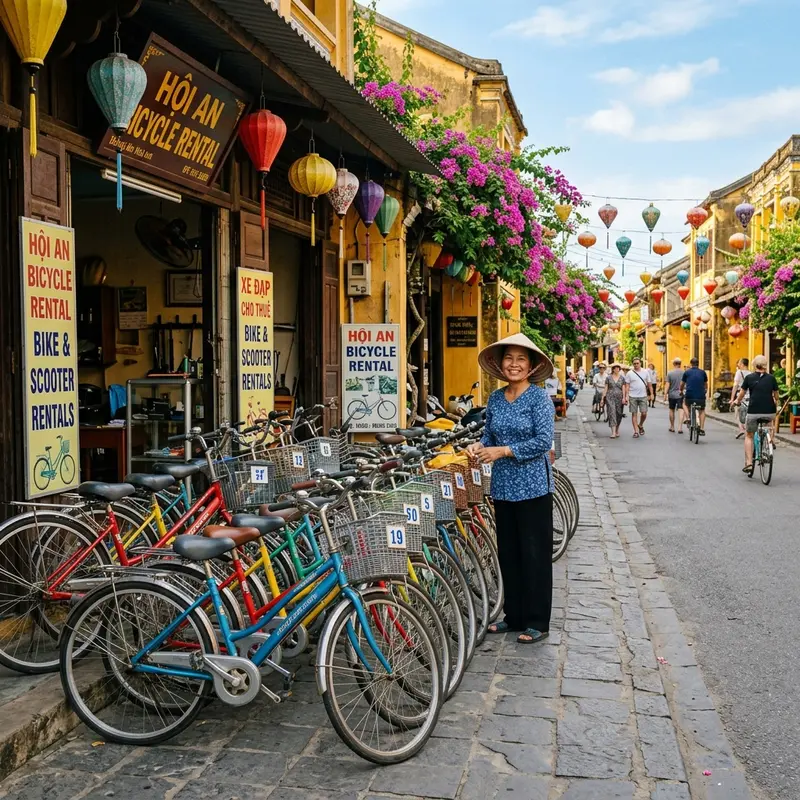
Hoi An has dozens of bicycle rental places, but not all of them are worth your money. After many times of “paying tuition” with flat tires in the middle of the road and chains slipping while climbing a bridge, I’ve identified some reliable addresses:
The areas around Nguyen Duy Hieu and Tran Phu streets are the two main thoroughfares with many bicycle rental shops. Shops located deeper in alleys, without grand signage, often rent out better quality bikes at lower prices compared to those with eye-catching storefronts targeting tourists.
Homestays and small hotels in the Old Town often offer free bicycle rentals or discounted rates for guests. If you’re staying at a local guesthouse, ask the owner directly — this is the best way to get a good bike at a reasonable price.
Tra Que Vegetable Village also has a few bicycle rental spots right at the village entrance, which is convenient if you plan to start your journey from here.
Actual Bicycle Rental Prices (Fair Prices)
Here’s the actual price range I surveyed recently:
| Bike Type | Daily Rental Price | Notes |
|---|---|---|
| Standard Bicycle (single speed) | 30,000 – 60,000 VND (≈$2) | Most common, sufficient for flat terrain |
| Bicycle with Gears (multi-speed) | 60,000 – 100,000 VND (≈$4) | Recommended for distances over 15km |
| Electric Bicycle | 80,000 – 140,000 VND (≈$5) | Suitable for the elderly or groups with children |
| Tandem Bicycle | 100,000 – 180,000 VND (≈$7) | Romantic for couples |
[!WARNING] Some shops near the entrance to the Old Town (especially the boat landing area) may charge up to 100,000 – 180,000 VND (≈$7)/day for a standard bicycle. Don’t agree immediately — walk an extra 200 meters into town, and the prices will be significantly lower. Always check the tires, brakes, and chain before accepting the bike.
Things to Check Before Taking the Bike
Here’s the “local’s checklist” I always follow before cycling:
- Inflate the tires: Squeeze both tires — they should be firm but not overly hard or flat. Ask for them to be re-inflated if necessary.
- Test the brakes: Pedal a few rounds and squeeze the brakes.. The brakes engage immediately, no delay.
- Check the chain: Roll the bike forward—the chain should run smoothly, without rattling or feeling loose.
- Adjust the seat height: The seat should be at the right height so your feet can touch the ground when needed. This is more important than you might think, especially when riding on dirt roads.
- Take a photo of the bike before you go: Document the bike’s condition (scratches, dents if any) to avoid disputes when returning it.
The Most Beautiful Cycling Routes Around Hoi An
Route 1: Ancient Town – Tra Que Vegetable Village – Hen Islet (15km – Half Day)
This route is for beginners, not too long, with flat terrain, and beautiful scenery from start to finish. I often take friends from Saigon on this route because it showcases the interesting contrast between the bustling ancient town and the peaceful countryside just a few kilometers away.
Detailed Itinerary:
- Start from the bicycle station in the Ancient Town (Bach Dang street along the river).
- Cycle along Cua Dai street for about 3km to Tra Que Vegetable Village—a famous organic vegetable village located by the clear Tra Que Lagoon. You can pay an additional 60,000 VND (≈$2) to participate in a vegetable-growing experience with local farmers.
- Continue cycling northeast towards Hen Islet—a small strip of land in the middle of the Thu Bon River, where people still fish and grow vegetables using traditional methods. The sunset view here, if you go in the afternoon, is incredibly impressive.
[!NOTE] Tra Que Vegetable Village opens at 7 AM. If you arrive before 8 AM, you’ll see farmers watering vegetables with ladles from the lagoon—a quintessentially Vietnamese scene that even younger generations of Hoi An residents rarely witness.
Route 2: Ancient Town – Cam Thanh – Bay Mau Coconut Forest (20km – Full Day)
This is my favorite route and one that I believe everyone visiting Hoi An should experience at least once.
From the Ancient Town, cycle along Nguyen Duy Hieu street towards the southeast, passing through vast rice fields in Cam Thanh commune. During the harvest season, the roadside is a stretching sea of gold—cycling through it feels like being in an ink wash painting.
The final destination of this route is Bay Mau Coconut Forest—a water coconut forest spanning over 100 hectares at the mouth of the Thu Bon River. Here, you can park your bicycles and rent basket boats (round coracles) for local residents to paddle you deeper into the coconut forest. The rental fee for a boat is approximately 150,000 – 240,000 VND (≈$9) per boat for 2-4 people.
Route 3: Ancient Town – Kim Bong Carpentry Village – Cham Islands (Full Day + Overnight)
This route is for experienced cyclists who want to explore further. From the Ancient Town, cycle to Bach Dang boat station, take a ferry across the south bank of the Thu Bon River to reach Kim Bong Carpentry Village—a woodworking village with over 500 years of history, where skilled artisans have built boats and houses for the entire Hoi An region.
From Kim Bong, you can continue cycling along the riverbank to Cua Dai boat station, then take a speedboat to Cham Islands—a coral island 18km offshore, a World Natural Heritage site. If you wish to stay overnight on the island, there are many small homestays with prices ranging from 200,000 – 480,000 VND (≈$19) per night.
What to Eat Along the Way? Delicious Eateries “Only Locals Know”
Breakfast before cycling
Never cycle on an empty stomach—this is rule number one. But don’t eat too much either, as it will make you tired while cycling.
Banh Mi Phuong (2B Phan Chau Trinh street) is a classic choice—Anthony Bourdain once called it “the best banh mi in the world”.“delicious”. A full banh mi sandwich with plenty of fillings costs only 25,000 – 40,000 VND (≈$2), enough energy for 2-3 hours of cycling.
But if you want to eat like a true Hoi An local, head to Phu Dong banh mi stall (Phu Dong street, near the primary school) – not as famous as Phuong, but locals eat here more often because it’s cheaper and has shorter queues.
Lunch amidst the countryside
While cycling through Cam Thanh, you’ll find small roadside stalls selling Hoi An chicken rice for 35,000 – 60,000 VND (≈$2) per plate. This is chicken rice cooked with chicken broth, with golden, rich grains, served with shredded chicken mixed with Vietnamese mint – completely different from Tam Ky chicken rice or Saigon chicken rice.
[!TIP] Look for chicken rice stalls with many local motorbikes parked in front – that’s a sign of a delicious and affordable place. Avoid stalls with big English signs near the ancient town – they are twice the price with no better quality.
Banh dap + mixed clams is a signature Hoi An snack combo you should try along the way. Banh dap is crispy grilled rice paper served with soft steamed rice paper, dipped in mam nem (fermented anchovy sauce) – costing only 10,000 – 20,000 VND (≈$1) per piece. Mixed clams are river clams stir-fried with herbs, roasted peanuts, served with rice crackers – 20,000 – 40,000 VND (≈$2) per bowl.
Best Check-in and Photo Spots Along the Route
”Million-like” shots that few people know about
Cam Thanh Bamboo Bridge: Located deep in Cam Thanh commune, there’s a bamboo bridge spanning a small canal – where the early morning light creates golden sunbeams filtering through the water coconut trees on both sides. This is a favorite photo spot for local professional photographers but is little known to tourists.
Tra Que Lagoon at dawn: Before the mist dissipates, the lagoon’s surface is as still as a mirror, reflecting the pale pink sky and the silhouettes of farmers watering vegetables – this is one of the most beautiful scenes I’ve ever witnessed in Central Vietnam.
Cam An Salt Fields: Few people know that Hoi An has small salt fields located north of the city, near Cam An beach. During the dry season (March – August), salt farmers head to the fields from 5 AM – the sunlight shining on the pure white salt pans creates an incredibly magical light effect.
[!NOTE] When photographing people at work, always ask for permission first. Hoi An people are very friendly and often agree, even posing for you. However, asking for permission is a way to show respect for the local culture.
Estimated Cost for a Day of Cycling in Hoi An Countryside
Here is the actual cost breakdown for one person (based on 2024-2025 prices):
| Item | Estimated Cost |
|---|---|
| Shuttle bus Da Nang – Hoi An (Faifo Express) | 150,000 – 240,000 VND (≈$9)/person |
| Bicycle rental for the whole day | 40,000 – 70,000 VND (≈$3) |
| Ancient Town entrance ticket (if needed) | 140,000 VND (≈$5) |
| Breakfast (banh mi + coffee) | 30,000 – 60,000 VND (≈$2) |
| Lunch (chicken rice or Mi Quang) | 40,000 – 70,000 VND (≈$3) |
| Snacks along the way | 30,000 – 60,000 VND (≈$2) |
| Basket boat ride in coconut forest (if applicable) | 75,000 – 120,000 VND (≈$5)/person |
| Craft village experience (optional) | 50,000 – 120,000 VND (≈$5) |
| Total | ~535,000 – 890,000 VND (≈$35) |
This is the cost for a day of incredibly rich experiences – compared to guided tours (often from 500,000 – 1,200,000 VND (≈$47)/person for just one activity), self-guided cycling is a much more economical and freeing option.
Practical Experience: Best Time to Go, What to Wear,And Crucial Tips
The Golden Time for Cycling
Early morning (5:30 AM – 9:00 AM) is the most ideal time. The weather is cool, the light is beautiful for photography, the roads are empty, and you can witness rural life waking up. This is also when local markets are bustling — a lively scene of colorful trading and vibrant sounds.
The afternoon (3:30 PM – 6:00 PM) is also beautiful, especially for watching the sunset over the Thu Bon River or at Con Hen. However, the temperature can still be high from 3:00 PM to 4:30 PM, so be sure to bring plenty of water.
Absolutely avoid cycling from 10:00 AM to 3:00 PM during the summer (May – August). Hoi An’s temperature can be
Frequently Asked Questions
Frequently asked questions about Hoi An
How should I use this guide for Hoi An: Rent a Bicycle to Explore the Countryside?
What is most important when booking Hoi An: Rent a Bicycle to Explore the Countryside?
Can Hoi An: Rent a Bicycle to Explore the Countryside work for families or larger groups?
What should I confirm before making plans for Hoi An: Rent a Bicycle to Explore the Countryside?
How can I avoid last-minute problems with Hoi An: Rent a Bicycle to Explore the Countryside?
Tags
The Faifo Express
This article was written by the driver and travel consultant team at Faifo Express — over 5 years of experience in travel transport across Da Nang, Hoi An, and Hue. All information is based on real experience serving 5,000+ customers every month.
Related services
Airport Transfer
Hotel pickup, all-inclusive price
View Details →Day Tour Car Rental
Ba Na Hills, Hoi An, My Son...
View Details →Shared Car
From just 100K VND/person
View Details →Tourist Car Rental
Explore the beauty of Central Vietnam with our private tourist car service.
View Details →🛣️ Popular Routes


Follow Faifo Express
Get exclusive deals, real reviews and the latest Central Vietnam travel tips.
Faifo Express
Updates, customer reviews & real trip photos.
@trm.anh.travel
Real experience videos, Da Nang – Hoi An travel tips.
@xedichvudananghoianhue
Real videos of routes, fleet and transfer services.
@xedananghoianFE
Quick news, flash deals and direct interaction.
DM us on Facebook — response within 5 minutes